FILE 022 / THE PHENOMENA FILES / HISTORICAL EVIDENCE
Nine hikers vanished into the freezing Ural night. Their tent was found weeks later. The injuries, snow and strange absences left room for extraordinary stories—but later snow-physics research has made a difficult natural explanation more testable.
The most important distinction is not between a ‘solved’ mystery and an ‘unsolved’ one. It is between what the 1959 record documents, what a modern avalanche model can plausibly explain and details that can no longer be recovered with certainty.
Read the evidence: the expedition · what searchers found · why the avalanche theory was disputed · 2021 physics · 2022 fieldwork · what remains unproven · our assessment · sources
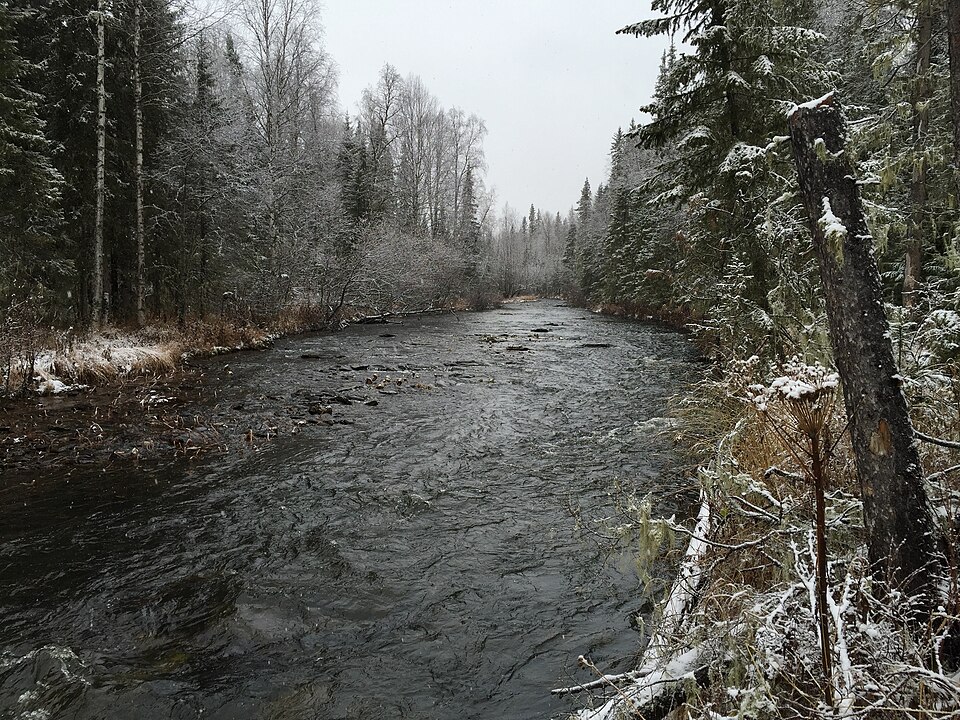

A river and a mountain pass are not the same place. This photograph supplies geographical atmosphere only. For the authentic tent-discovery photograph and the group’s last campsite image, the 2021 scientific paper reproduces credited historical pictures from the Dyatlov Memorial Foundation. We link to that work rather than republishing those images without separate permission.
A difficult expedition, not an anonymous legend
In January 1959, a group led by Igor Dyatlov undertook a demanding ski trek in the northern Ural Mountains of the Soviet Union. Ten people had set out on the wider trip; Yuri Yudin turned back because of illness, leaving nine to continue. The group’s diaries, letters and route documentation survived in part. Their individual identities and decisions deserve more care than the familiar shorthand ‘nine mysterious bodies’.
The party camped on a snow-covered slope below Kholat Syakhl, reportedly making a cut into the snow to prepare a tent platform. The principal fatal events occurred during the night of February 1–2, 1959. No surviving member was present to give a first-person account of that night. Later reconstructions necessarily work backward from physical traces, documents and the timing of recovery.
The preserved diaries and the investigation file are accessible through a specialist document archive and scanned 1959 case-file index. Those online English transcriptions are research aids rather than new official translations by DEVIL13; where a date, wording or interpretation matters, the original scan should be checked.
The 2021 analysis by Johan Gaume and Alexander Puzrin uses the documented campsite and snow conditions as the starting point for a physical model, rather than trying to deduce a cause from the drama of the later headlines.
What searchers documented—and why it was unsettling
- Abandoned tent. Searchers located the snow-covered campsite several weeks later; the tent had been damaged and was understood to have been cut from the inside. The recovered gear indicated that the party left without adequate protection for the conditions.
- Tracks downslope. Accounts described traces heading toward the forest. The physical evidence suggests movement away from camp, but the exact order and motivations of nine individuals cannot be reconstructed like recorded video.
- Different recovery locations. Searchers found the hikers at different places between the tent and forest. Some appeared to have tried to survive near trees or return uphill, but chronology and decisions are inferred.
- Different injuries. Severe head or chest injuries were recorded for several individuals, while cold exposure played a major role in the disaster. The injuries demanded a physical explanation but did not, by themselves, identify a perpetrator.
- Delayed examination. Snow, wind and weeks of exposure intervened before the campsite was studied. Recovery conditions constrain how confidently the original snow surface and avalanche traces can be reconstructed.
These observations are drawn from the published researchers’ examination of the Soviet investigation and from an online index to translated 1959 case documents. Different secondary timelines sometimes disagree on exact recovery dates; the general chronology should not be inflated into spurious precision.
Some accounts foreground missing soft tissue and traces of radioactivity. Those details are real subjects for documentary scrutiny, but they are not self-authenticating evidence of a weapon, deliberate attack or extraterrestrial origin. Any proposed explanation must establish a credible source, timing and connection to the deaths.
Four reasons the avalanche theory once looked implausible
A conventional avalanche story seemed to clash with the evidence. The average slope appeared gentle. Searchers described no obvious large avalanche debris field. The tent was reportedly cut into the snow hours before the fatal event, not immediately before it. And several injuries seemed severe for an ordinary small slide.
Those were substantive objections rather than irrational resistance to a scientific answer. The strength of the 2021 paper was that it tried to explain them with testable mechanics rather than asking the reader to ignore them.
- Slope angle: a broad average below about 30° can conceal steeper local layers and an uneven shoulder above a tent.
- Absence of conspicuous debris: a limited snow slab may travel only a short distance and leave traces that later wind loading disguises.
- Hours of apparent delay: a cut in the snow need not trigger immediate release if new windblown snow progressively increases the load.
- Severe injuries: a compact, dense slab striking people against a confined tent floor may create a very different force from a person being swept downhill by a large avalanche.
Each sentence above describes a mechanism proposed or simulated by the researchers. None is a contemporaneous measurement of the actual 1959 slab.
The 2021 model: how a small slab could fail hours later
In the peer-reviewed paper “Mechanisms of slab avalanche release and impact in the Dyatlov Pass incident in 1959”, Johan Gaume and Alexander M. Puzrin combined an analytical model of a weak snow layer with numerical simulations of a small slab striking people inside the tent. Their model depends on several factors acting together:
- Local terrain rather than the average hillside. The campsite was near irregular slope steps and a shoulder that could shelter people from the wind while concentrating transported snow above them.
- A cut into the snowpack. Digging a platform could reduce support for a relatively thin slab resting on a weaker layer.
- Wind loading. Persistent katabatic winds could deposit snow behind the shoulder, increasing stress gradually instead of causing immediate failure.
- Delayed fracture. Under the researchers’ assumptions, modeled failure could occur roughly 7.5–13.5 hours after the original cut.
- Limited impact. Simulations showed a comparatively small slab could produce strong impact on people lying in the tent without the long runout that people associate with major avalanches.
The exact number of hours is a model output, not a timestamp observed in 1959. Changing the assumed snow density, friction, loading rate, terrain or impact configuration changes the output. The model’s scientific value is that it answers concrete objections and produces scenarios one could examine, not that it turns a seventy-year-old scene into a certainty.
The work was published in Communications Earth & Environment on January 28, 2021 and is openly accessible through the journal and ETH Zürich’s research page.
The 2022 fieldwork: what new observations added
A useful distinction separates the 2021 model from the researchers’ later expeditions. In a March 2022 published follow-up, Puzrin and Gaume described subsequent visits that tested their assumptions against the actual surrounding terrain.
Drone measurements found localized slopes steep enough for slab release. Nearby field teams recorded evidence of recent slab avalanches, including a January 2022 event on an eastern slope a few kilometres from the group’s former campsite. The researchers also observed that wind-transported snow could quickly obscure signs of a smaller slide. EPFL’s interview with the authors explains both the confirmation of local avalanche-prone terrain and the limits imposed by weather on direct tests.
That is a meaningful update. Before this fieldwork, critics could argue the location was intrinsically too gentle for slab avalanches. Afterward, there was observational evidence that such avalanches can occur in the area. However, a slide recorded more than six decades later and a few kilometres away is not the missing photograph of the 1959 event.
The authors themselves described their 2021 argument as a plausible physical explanation, not incontrovertible proof of the precise fatal sequence. Their 2022 fieldwork strengthens a mechanism; it does not let us replay the winter night.
What the model still does not settle
It is tempting to say that avalanches ‘solved everything’, just as it is tempting to say that difficult details disprove all natural explanations. The evidence does not warrant either shortcut.
- The exact immediate trigger. No instrument measured the snowpack and wind deposition at the tent in February 1959. Small changes in assumptions can alter the release timeline.
- Every person’s movements. The model addresses an initial hazardous event and plausible injury mechanisms; it does not reconstruct each person’s choices and movements after leaving camp.
- All postmortem details. The paper does not turn every medical, tissue or clothing observation into a direct avalanche measurement. Those claims need their own source-level work.
- What a witness might have seen. Later reports of lights, noises or alleged military activity cannot be assigned to the campsite without independent time-and-place evidence.
- Absolute exclusion of every alternative. A credible explanation need not logically rule out every imagined possibility. Competing claims must be judged against the actual physical record, not simply kept alive because a full reconstruction is impossible.
A disciplined conclusion can therefore be strong about the plausibility of a snow-slab release and cautious about unobserved personal decisions. Responsible uncertainty is not the same as treating a Yeti, secret military test and peer-reviewed snow model as equally supported.
Five evidence questions worth asking
- Which statement is contemporary? A 1959 recovery document, a later translation, a 2021 model, and a 2022 field observation are four distinct evidence types.
- What is the physical measurement? Identify the slope geometry, snow-layer tests, photographs or recorded injuries that actually exist rather than drawing an entire scene from a dramatized animation.
- What is being simulated? List model inputs, assumptions and the range of possible outcomes. Do not promote a possible scenario into a confirmed historical sequence.
- What changed after publication? Later evidence of local slab avalanches strengthens the mechanism but doesn’t retroactively provide a measurement of the 1959 snowpack.
- What would change the assessment? Relevant new physical records, authentically dated photographs or improved replicated models could refine one inference; another viral retelling would not.
Try the free Evidence Engine for broader claim analysis, or use the Historical Source Record to keep a translated document separate from the underlying archival scan.
DEVIL13 evidence assessment
Documented: the fatal expedition and recovery
Nine experienced hikers died during a winter trek in February 1959 after Yuri Yudin had returned. A damaged tent and later recovery sites were documented in Soviet case materials and used by later researchers. No surviving member witnessed the full fatal night. This publication reports a historical record, not DEVIL13’s own investigation of the physical site.
Supported explanation: a small delayed slab avalanche
The 2021 peer-reviewed work provides a physically modeled mechanism joining the snow platform cut, local topography, weak snow layer and wind-blown loading. Its simulations can reproduce a delayed release and severe impacts. Later field observations support the proposition that the area is capable of slab avalanches. This strongly increases plausibility but is not direct proof that this exact slide occurred in 1959.
Open questions and misused evidence
The original snow state, every person’s movements and the significance of some later medical or anecdotal claims remain imperfectly known. Radiation, missing tissue, glowing lights and rumors of military involvement cannot be taken as stand-alone proof of non-natural causes. Inconsistent translations and delayed recovery should be flagged, not silently resolved by dramatic storytelling.
What could require a correction or update
A reliably authenticated new primary record, a reproducible alternative model that fits the injuries and snow dynamics better, clear evidence contradicting a central geometric assumption, or additional independently verified field measurements could change a specific assessment. DEVIL13 would identify the claim, date and evidence in an update rather than quietly rewriting the record.
Our finding: A small, delayed snow-slab avalanche is a credible and increasingly supported explanation for the event that drove the group from its tent. The precise historical sequence cannot be proven in full. It is not scientifically necessary to invent an extraordinary perpetrator simply because the surviving evidence is incomplete.
Explore the Phenomena Files → · Compare another mystery with a physical explanation →
Sources, provenance and limits
- Gaume & Puzrin (2021), “Mechanisms of slab avalanche release and impact in the Dyatlov Pass incident in 1959,” Communications Earth & Environment. Open-access peer-reviewed physical modelling of the slope, delayed loading and possible impact injuries.
- Puzrin & Gaume (2022), “Post-publication careers: follow-up expeditions reveal avalanches at Dyatlov Pass,” Communications Earth & Environment. Follow-up observations and candid comparison with the 1959 conditions.
- EPFL, “Intense press coverage prompts new expeditions to Dyatlov Pass.” Researcher interview about the drone survey, new observed avalanches and tests the weather prevented.
- ETH Zürich, Dyatlov Pass research project. Institutional description of the proposed mechanism and credited historical images.
- Dyatlov Pass document archive, 1959 case files and scans. Specialist third-party host for originals and transcriptions. Translated text should be checked against the scanned Russian document when precision matters.
- Dyatlov Pass diary and chronology archive. Specialist document collection with dated material and explanatory notes.
- Futball80 (2015), Auspiya River photograph, Wikimedia Commons. CC BY-SA 4.0, resized copy, no creative modifications; image gives wider route-area context, not the incident site.
Research synthesis prepared November 24, 2026. DEVIL13 did not conduct fieldwork, recreate the hikers’ injuries or verify the authenticity of every translated archival page. Model-derived quantities and later field observations are clearly distinguished from contemporaneous measurements. This article treats nine deaths with respect; unverified extraordinary allegations are not presented as facts.
For the limits of inferred historical dates, see What Does a Timestamp Prove?. To report a documentary correction, use Contact & Corrections.