FILE 019 / THE PHENOMENA FILES / COSMIC AIRBURST
A forest flattened. Witnesses describing a fireball. No obvious impact crater. The explosion over Siberia in 1908 is real; the absence of a hole in the ground is not proof that the cause was impossible.
Evidence brief: A cosmic airburst is the leading scientific explanation, with an asteroid favored by much of the modern literature. The exact incoming object, energy-release history, surviving debris and the origin of nearby Lake Cheko remain more narrowly disputed than the basic event.
Follow the file: 1908 and the records · five evidence streams · the absent crater · sizes and models · Lake Cheko debate · the current finding · sources
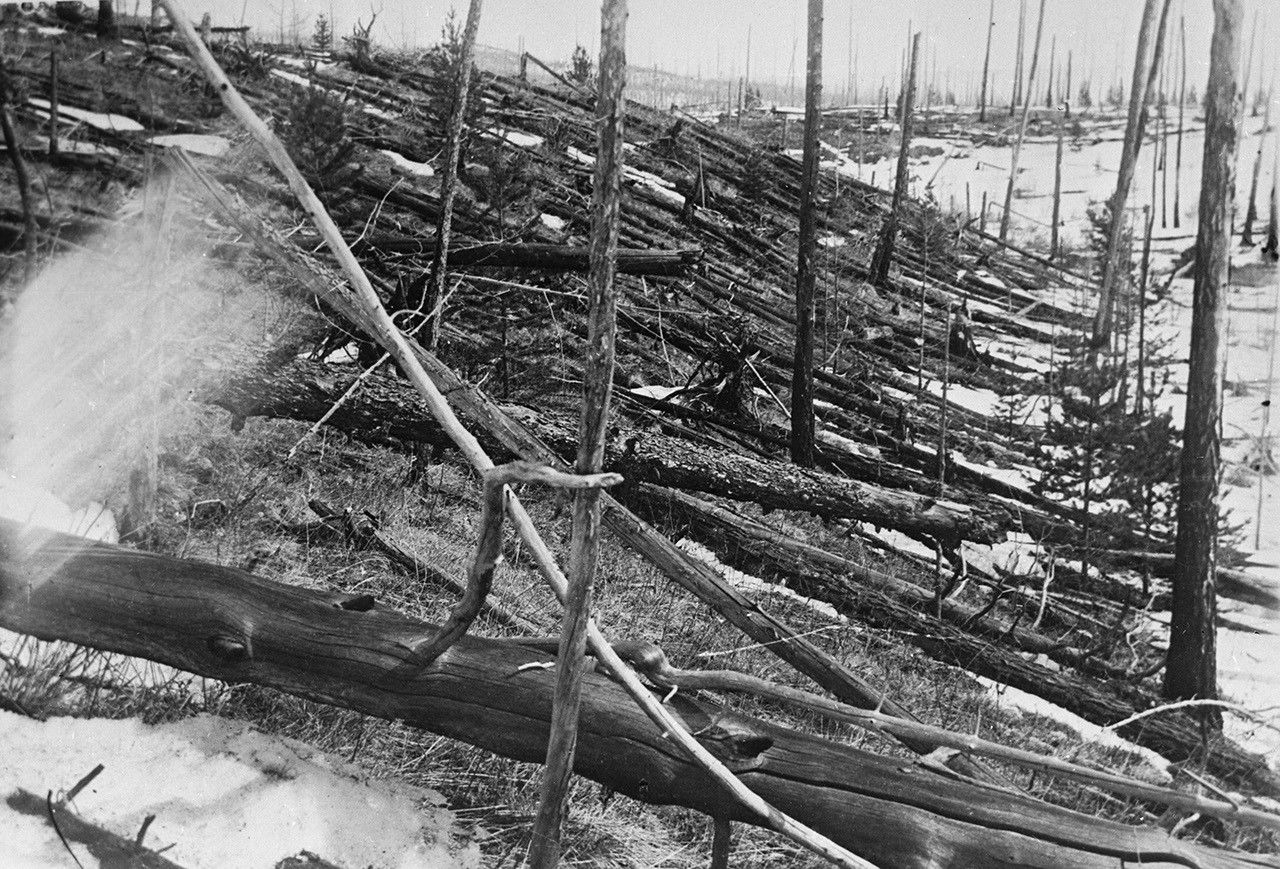
The image is unusually revealing: the extraordinary physical destruction was preserved long enough for researchers to photograph it, but the camera arrived years after the blast. That distinction matters. A field photograph records damaged trees; it cannot directly show the incoming object’s composition or its final moments.
An explosion, then a long silence in the scientific record
On June 30, 1908, a luminous object crossed the sky near the Podkamennaya (Stony) Tunguska River in central Siberia. People in the region described a fireball, a violent sound and shock effects. NASA recounts damage to encampments and forests in an area so remote that organized investigation lagged far behind the event. These witness accounts deserve to be treated as human experiences, not as interchangeable instrument readings. NASA’s historical review includes the importance of Evenki eyewitnesses and the later expeditions.
- 1908 — the event. An airburst or explosion shocks the remote region. Contemporary seismic and pressure-wave observations become part of the later scientific case; firsthand stories are collected and translated at different times.
- 1921 — an incomplete first effort. Geologist Leonid Kulik’s early expedition cannot reach the principal blast area.
- 1927 — the site finally examined. Kulik reaches the damaged forest, documenting the surviving pattern of fallen and stripped trees nearly two decades after the event.
- 1950s–1960s — the landscape mapped further. Later surveys clarify a broad, roughly butterfly-shaped zone of tree damage, rather than yielding a conventional central crater.
- 2013 — a modern comparison. The Chelyabinsk airburst supplies camera, sensor and damage observations unavailable in 1908, giving researchers better ways to test models.
- 2018 — reassessment at NASA Ames. A workshop studies the older evidence using computational tools refined after Chelyabinsk, while emphasizing that the historical observations are limited.
This is a chronology of the evidence, not a claim that every witness statement was written down in 1908. NASA’s 2018 technical memorandum says accounts were often collected decades later, so the timing and transmission of testimony matter.
Five kinds of evidence—and their limits
1. People saw and felt it
Eyewitness descriptions include light, noise and powerful physical effects. Accounts are essential but vary by vantage point and were not all recorded promptly.
2. Trees retained the shock
Years later, fallen and debranched trees mapped a huge blast zone. This is material evidence of extraordinary force, but patterns require physical modelling to interpret.
3. Instruments registered effects
Seismic and atmospheric pressure signals were among the evidence examined later. They establish a major disturbance, not the precise chemistry of the object.
4. The sky behaved unusually
Bright or ‘white’ nights were reported in northern Europe. High-altitude dust and water effects offer possible mechanisms, but this is not a direct photograph of the impactor.
5. Missing large fragments and crater: Scientific teams did not establish a conventional main impact crater or recover a definitive large remnant of the cosmic body. Those absences constrain models; they do not erase the other evidence. In the NASA workshop summary, the main obstacle is the scarcity of quantitative historical data, not an inability of airburst physics to reproduce damage.
Why would a cosmic impact leave no obvious crater?
The intuitive picture is a solid rock striking the soil and excavating a bowl. But a fast-moving body can break apart, heat and disperse while still high in the atmosphere. A large fraction of its kinetic energy can be transferred to air, creating shock and thermal effects at the ground without one intact mass reaching it. ‘Impact event’ in planetary science can therefore refer to an atmospheric impact, not necessarily a solid collision that leaves a crater.
NASA’s Earth Observatory account and Tunguska reassessment describe this distinction. Modern comparisons with the Chelyabinsk event support the general mechanism of explosive fragmentation in the atmosphere. They do not identify the 1908 object molecule by molecule.
A missing crater would be a serious problem for a model that specifically predicts an intact large object striking the ground. It is not a surprise for a model in which the principal energy was released overhead. The useful research question is not ‘Where is the hole?’ by itself. It is: What observable pattern does each proposed mechanism predict, and how closely does that match the site?
What the numerical models suggest
At a January 2018 NASA Ames workshop, expert presentations converged on a favored model range of roughly 10–20 megatons of TNT equivalent released during an airburst at around 10 kilometres altitude. Under an assumed stony asteroid composition similar to the well-studied Chelyabinsk object, the estimated original diameter was approximately 50–80 metres. These are model-dependent estimates summarized in the published NASA technical memorandum, not direct measurements from 1908.
Different published models and assumptions yield different values. Entry angle, density, strength and fragmentation history affect the calculation. Replacing all that uncertainty with a single precise number gives a false impression of measurement. The workshop’s central warning remains useful: abundant modern computing power cannot recreate evidence never recorded in 1908.
The airburst explanation is strong because multiple types of evidence—tree damage, shock observations, witness accounts and plausible physics—can be made mutually consistent. The uncertainty within the model is a reason to preserve ranges, not to treat a speculative alternative as equally supported.
The most interesting remaining dispute: Lake Cheko
One nearby lake has drawn particular attention because it sits close enough to the inferred path that a surviving fragment might, in principle, have struck there. In 2007 a team led by Luca Gasperini proposed that Lake Cheko could occupy a secondary impact crater. The dispute reached a detailed, published scientific exchange in 2008.
Argument for an impact origin
Gasperini and colleagues emphasize the lake’s shape, subsurface acoustics, proximity to a reconstructed trajectory, and sediment interpretations consistent with a relatively young lake. They also acknowledge limits in the older maps and oral accounts. Read their 2008 reply.
Argument against an impact origin
Collins and colleagues question the lake’s crater-like morphology, point to apparently unaffected mature trees nearby and the absence of definitive impactor material, and argue that a suitably robust surviving fragment is improbable under ordinary stony-body breakup models. Read their 2008 critique.
What would resolve the claim? Strong independent dating of the lake’s formation and compelling diagnostic impact evidence would matter more than a photograph of a rounded lake or a dramatic headline. An old map’s failure to label a small remote feature is not proof the feature did not exist. Nor is a young-looking sediment layer proof that the lake began with the 1908 event.
The fair conclusion is narrower than either sensational certainty: the crater claim has been argued in peer-reviewed literature, but Lake Cheko is not established as a confirmed Tunguska impact crater by the sources examined here. The broader cosmic-airburst interpretation does not require it.
What about a comet—or stranger explanations?
NASA’s workshop document describes a cometary body and a stony asteroid as historically examined cosmic hypotheses, while asteroid models are commonly preferred today. Because the large object was not recovered, its exact composition is inferred rather than directly sampled. ‘An asteroid’ is therefore a well-supported class of explanation, not an identified specimen in a museum drawer.
Stories involving secret weapons, extraterrestrial spacecraft and extraordinary energy sources have circulated around Tunguska. Their popularity is evidence that a mystery attracts narratives, not evidence that a proposed cause occurred. A causal hypothesis must account for the time, location, physical damage and measured disturbances, and it should provide distinctive evidence that is not already explained by the airburst models. Absence of a crater alone cannot do that work.
If independent, reliably dated material incompatible with a natural airburst were recovered, the scientific picture should change. No such finding is established by the reviewed sources. Dismissing possibilities without checking evidence is poor reasoning; treating every possibility as equally plausible despite unequal evidence is also poor reasoning.
DEVIL13 evidence assessment
Established by the available record
A major destructive event occurred on June 30, 1908 in remote Siberia; witness testimony, later tree-damage surveys and recorded geophysical/atmospheric effects form the evidence. The absence of a conventional crater has been a recurring part of that record. These statements do not require a perfect reconstruction of the incoming object.
Leading explanation, with model uncertainty
A cosmic body released most of its energy in an atmospheric airburst; many researchers favour a stony asteroid. Estimates for size, angle, energy and altitude depend on modelling assumptions and incomplete historical observations. NASA’s 2018 expert workshop is the cited basis for the numerical ranges used in this article.
Still debated or incompletely established
Whether any particular small debris is conclusively linked to Tunguska, the exact original composition and trajectory, and whether Lake Cheko was formed by a surviving fragment remain narrower questions. Competing published positions on Lake Cheko are linked above; neither should be disguised as a verified eyewitness account of 1908.
What would change our reading
Well-dated, authenticated impactor material, robust geological evidence for a crater, new historically sourced instrumentation records, or independently reproducible models that better explain the full pattern could refine the assessment. An additional repetition of a popular story would not supply independent evidence.
Bottom line: Tunguska is not a case where scientists cannot explain a real explosion. It is a case where the principal cause is strongly modeled, while some physical details remain unknowable or disputed. That boundary is more compelling—and more useful—than a premature claim of total mystery.
Use the Evidence Engine to test a proposed extraordinary explanation, the Historical Source Record to separate eyewitness dates from later expedition records, or the Source Trail Record to distinguish independent observations from repeated retellings.
Source desk and methodology
- NASA History (2023), “115 Years Ago: The Tunguska Asteroid Impact Event” — contemporary event overview and expedition chronology.
- David Morrison, NASA Technical Memorandum 220174 (2018), “Tunguska Workshop” — assumptions, estimated ranges and data limitations; workshop synthesis, not a new sample collection.
- NASA Earth Observatory, “A Cosmic Explosion Over Siberia” — airburst and landscape context.
- NASA (2019), “Tunguska Revisited” — models and the value of the Chelyabinsk comparison.
- Collins et al. (2008), “Evidence that Lake Cheko is not an impact crater” — peer-reviewed arguments opposing the lake-impact hypothesis.
- Gasperini, Bonatti and Longo (2008), “Lake Cheko and the Tunguska Event: impact or non-impact?” — peer-reviewed reply supporting the hypothesis.
Research synthesis prepared November 21, 2026. NASA’s technical memorandum is a workshop summary; its estimates are model-dependent. This article does not claim independent examination of seismic records, sediment cores, field sites or 1908 eyewitness manuscripts. The historical forest photograph was copied from NASA with its photographer credit and belongs to a later expedition, not the moment of the event. Secondary framing, uncertainty and disagreements are deliberately identified.
Continue with the Antikythera Mechanism for another striking physical discovery, the Voynich Manuscript for an unresolved text, or our editorial method for the rules behind these investigations.