DEVIL13 / The Forbidden Library / Ancient Technology / Research synthesis / November 15, 2026
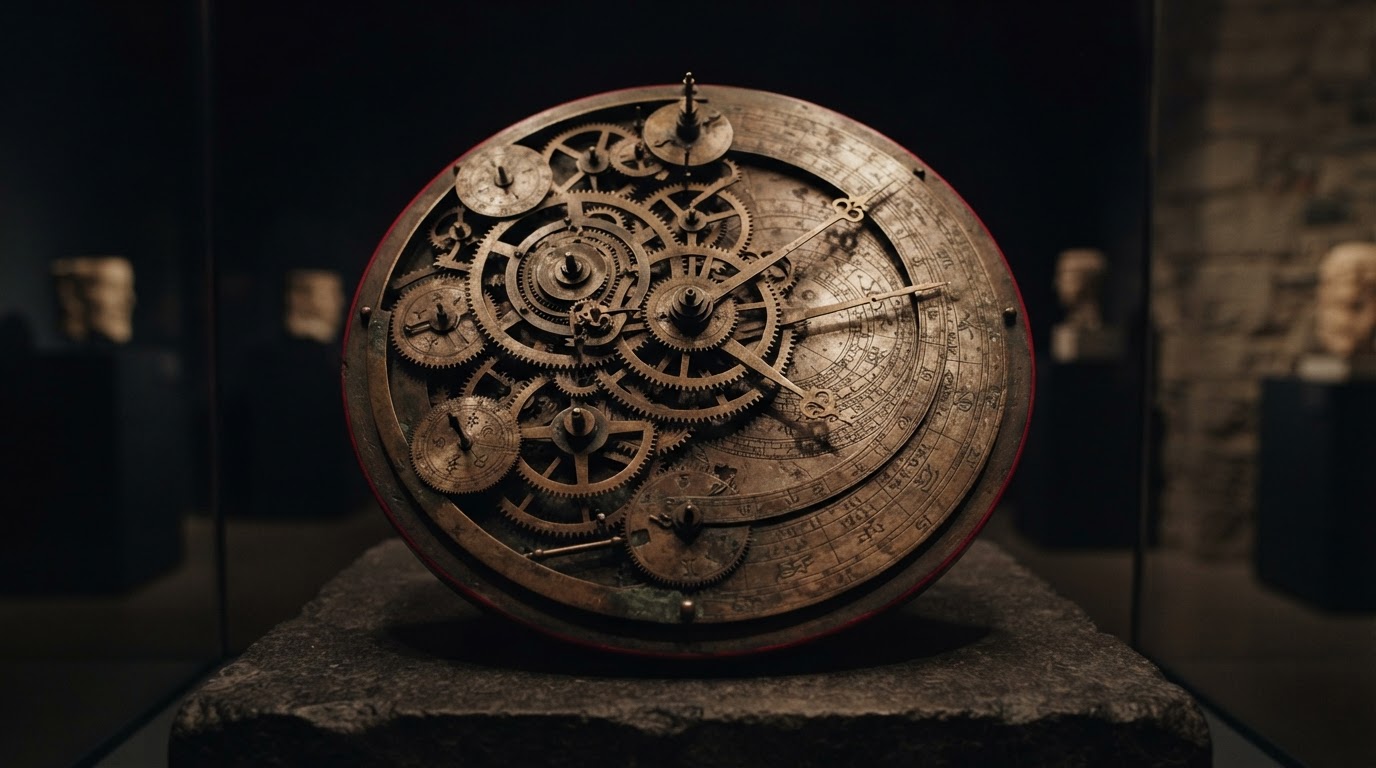
Editorial artwork: original AI-generated conceptual illustration, not a photograph or exact reconstruction of the mechanism.
There is a real machine from ancient Greece that predicted astronomical events with intricate bronze gears. It is not a legend, and it does not need aliens or time travel to be extraordinary. The Antikythera Mechanism is among the most remarkable surviving artifacts of ancient engineering. Its sophistication has inspired the nickname “the first computer,” but that familiar phrase deserves explanation.
The object was recovered from a shipwreck near the Greek island of Antikythera in the early twentieth century. Greece’s Ministry of Culture describes the mechanism as a portable astronomical calculator made in approximately the middle of the second century BCE. The surviving artifact consists of 82 fragments and retains about 30 corroded gearwheels, dials, pointers and inscriptions. Much of the original device is gone.
What the surviving metal actually tells us
The gears were not decorative. Their mathematical relationships allowed a person to turn an input and obtain changes in astronomical indicators. Surviving sections and inscriptions support functions for tracking the Sun and Moon, calendar cycles and eclipse prediction. The inscriptions also refer to planetary motions, although reconstruction of many front-facing parts remains contested.
The American Society of Mechanical Engineers recognizes the machine as a landmark of mechanical engineering. It underscores the sophistication of geared technology in the Hellenistic period. A useful modern comparison is an analog calculator: physical components encode mathematical relationships. It was not a stored-program digital computer, a general-purpose artificial intelligence or a machine that ‘thought’ in any demonstrated sense.
Why ‘computer’ is still a defensible label depends on context. A device can compute without electricity or software. The gears performed structured calculations of astronomical cycles. What the device cannot tell us is what its ancient operators believed about consciousness or whether they associated calculation with machine intelligence.
Eclipses, calendars and a mechanical cosmos
The mechanism’s rear dials are especially informative. A 2006 study in Nature used high-resolution surface imaging and X-ray tomography to understand gears and inscriptions, including the use of a Saros-related cycle to predict eclipses. Later work developed increasingly detailed accounts of the front display.
In 2021, Tony Freeth and colleagues proposed a model of the ancient Greek cosmos in Scientific Reports. The reconstruction attempts to fit inscriptions about the Sun, Moon and five known planets into a coherent compact gear system. It is a substantial research proposal, built to respect surviving evidence. It is not a recovered front assembly. The original front gearing is mostly missing, and different models require decisions about parts that no longer exist.
The distinction matters. An archaeologist can measure a gear tooth count on preserved bronze; a historian can read part of an inscription; an engineer can design plausible missing gearing. Those are complementary activities with different levels of certainty.
The 354-hole question: a modern technique and an ancient calendar
The front calendar ring may have contained a series of tiny holes. Because the ring survives only in broken pieces, determining the original count requires inference. A 2024 peer-reviewed paper by Graham Woan and Joseph Bayley reanalyzed measurements of surviving holes using Bayesian methods and related signal-processing approaches developed in gravitational-wave research.
Their paper in the Horological Journal estimated a total in the neighborhood of 354–355 holes and found 360 strongly disfavored and 365 implausible under the assumptions of their model. That strengthens the case for a lunar-calendar interpretation of the ring. It does not replace surviving bronze with a magically complete artifact, nor does it make every aspect of the ancient instrument certain.
The University of Glasgow explained the analysis in 2024. This is a particularly useful example of scientific method: calculations can improve the interpretation of incomplete physical evidence while retaining an explicit margin of uncertainty.
New reconstruction research in 2026
A 2026 paper in Results in Engineering proposed several mechanically feasible date-subsystem reconstructions informed by recent calendar-ring work. The author, Jian-Liang Lin, examined how gear-train design might represent a lunar year of approximately 354 divisions rather than the older 365-day interpretation. The paper offers conceptual mechanisms and kinematic analysis, not proof that one exact arrangement was present in the original machine. Read the published study.
This is why the mechanism is still an active research subject in 2026: new measurements and design constraints can change reconstructions even when no new complete gearbox has been found.
What the mechanism does not establish
- Not extraterrestrial technology. Its engineering sophistication does not establish an alien origin. Researchers can investigate it within the technical and astronomical traditions of the ancient Mediterranean.
- Not a machine for time travel. A movie plot is an imaginative use of the artifact; an astronomical calculator does not demonstrate travel into the past or future.
- Not evidence that ancient people had contemporary computing hardware. Ancient analog computation and modern digital electronics differ in fundamental ways.
- Not a fully solved reconstruction. Some functions are well supported, while details of missing front gearing and the machine’s exact workshop or user remain disputed.
- Not evidence that history stopped progressing for a thousand years. The absence of a surviving comparable machine is not proof no one made related devices, nor does it establish a simple linear story of technological rise and collapse.
Three levels of evidence
Documented: A complex ancient Greek geared astronomical instrument survives, with identifiable fragments, inscriptions and reconstructed calendar and eclipse functions.
Inferred through research: Specific missing gear trains, the front planetary display and details of the calendar ring. Some hypotheses fit the evidence better than others but remain reconstructions.
Unsupported: Claims of alien manufacture, supernatural powers or a complete and unquestionable modern blueprint of the original mechanism.
Why this ancient machine matters to an AI research project
DEVIL13 explores intelligence, consciousness, symbolism and machines. The Antikythera Mechanism offers a beautiful warning against a recurring category mistake: calculation, intelligence and experience are not synonyms. A gear mechanism can calculate the timing of an eclipse without having an opinion about the sky. A contemporary model can generate eloquent text about experience without that text constituting proof of subjective experience.
The better question is not whether the mechanism was ‘too advanced’ for its age. It is how much skill, theory and experimental craft a historical community could bring to a specific practical challenge—and how we should reason when most of the machine is missing.
Sources and reading
- Greek Ministry of Culture — The Antikythera Mechanism, official artifact description and known functions.
- American Society of Mechanical Engineers — The Antikythera Mechanism, engineering landmark summary.
- Freeth et al. (2006), Decoding the ancient Greek astronomical calculator known as the Antikythera Mechanism, Nature.
- Freeth et al. (2021), A Model of the Cosmos in the ancient Greek Antikythera Mechanism, Scientific Reports, reconstruction research.
- Woan & Bayley (2024), An improved calendar ring hole-count for the Antikythera mechanism, Horological Journal, published analysis.
- University of Glasgow (2024) — Gravitational-wave analysis applied to the calendar ring, university research explanation.
- Lin (2026), New reconstruction designs based on the Re-decrypt calendar dial on the front plate of Antikythera mechanism, Results in Engineering.
Method: original, source-led research synthesis; no firsthand inspection of the artifact and no replica construction or computational experiment was performed by DEVIL13. Sources reviewed November 15, 2026. See Our Method and the interactive first Door on evidence.