DEVIL13 / The Forbidden Library / Documented mystery / Research review: November 15, 2026
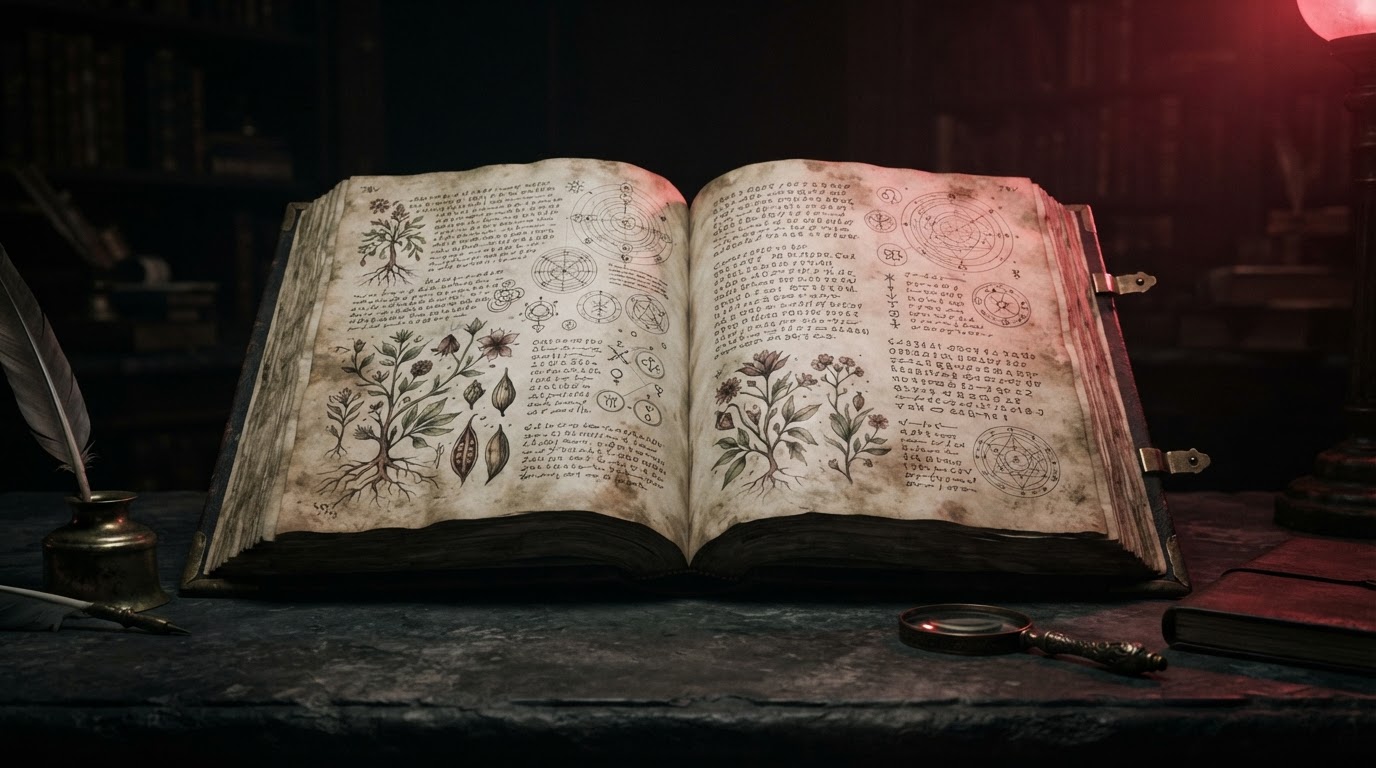
The featured artwork is an original AI-generated conceptual illustration, not a reproduction of Beinecke MS 408.
The most important fact about the Voynich Manuscript is not that it contains a secret. It is that we do not yet know what its writing says. For more than a century, a small illustrated book has attracted linguists, historians, cryptographers, amateur codebreakers and, more recently, machine-learning researchers. The mystery is real. Many confident explanations are not.
The book is held at Yale University’s Beinecke Rare Book & Manuscript Library as MS 408. Its pages show unfamiliar writing alongside plants, stars, bathing figures, diagrams and what appear to be preparations involving herbs. Yale still describes the script as unidentified and the text as undeciphered. That is the starting point—not evidence of a lost civilization, extraterrestrial origin or an ancient prophecy.
What can actually be verified?
- The object exists. Yale preserves the manuscript, documents its provenance and provides high-resolution digital images of the entire surviving work for research.
- The writing is not understood. There is no accepted reading that reliably translates the text.
- The illustrations have recognizable themes. Yale identifies conventional herbal, astronomical/astrological, bathing, cosmological, pharmaceutical and text-heavy sections. The subject matter of each passage is still uncertain.
- Its history can be traced in part. The manuscript surfaced on the rare-book market through Wilfrid Voynich in 1912, though its known ownership history extends further back.
- Material evidence has limits. Scientific examination is consistent with a historical manuscript. Dating writing materials does not by itself tell us what the author meant or on precisely which day the text was composed.
These are not small findings. They let researchers study a particular physical artifact, with catalog records and images, instead of debating an inaccessible legend. Yale’s collection overview is the best place to begin; its access guidance explains why researchers ordinarily use digitized pages rather than handle the fragile original.
A provenance with facts—and famous guesses
The manuscript is named for the bookseller Wilfrid M. Voynich, who purchased it in Italy in 1912. But he was not its creator. Yale records earlier owners and a seventeenth-century letter by Johannes Marcus Marci to the Jesuit scholar Athanasius Kircher. Over the years the manuscript was associated with the thirteenth-century philosopher Roger Bacon and with the Elizabethan scholar John Dee. Yale explicitly describes the Bacon attribution as speculation and says the proposed Dee connection has been seriously questioned.
A useful historical lesson appears here: a name attached to an object may be part of that object’s reception history, not proof of authorship. Even the most seductive provenance story has to survive the documents.
Why the pictures are helpful but insufficient
A plant drawing is not necessarily a botanical identification, and an image of a star does not tell us whether its surrounding words describe astronomy, astrology, a calendar or something else. The illustration categories give researchers working hypotheses, not reliable translations.
The book’s organization may also be more complicated than it first seems. Some pages fold out; portions are missing; the order and structure of the surviving text are active research questions. Treating today’s binding as an unquestionable reflection of the author’s plan could lead analysts astray.
What changed in 2026?
A 2026 study by Colin Layfield and manuscript scholar Lisa Fagin Davis, Singulion Structure and the Voynich Manuscript, uses computational comparisons with other historical texts to investigate whether the manuscript originally functioned as a sequence of individual bifolia rather than conventionally bound gatherings. It is a proposed structural interpretation, not a decipherment. If its argument holds, it could affect which pages analysts compare and in what order. The published research can be found at DOI: 10.4000/16k0a.
In September 2026, Torsten Timm published a separate research article asking whether conventional approaches have struggled because they assume a fixed underlying text-production system. That proposal, too, offers a way to investigate the structure of the writing. It does not tell us what the text says.
These two lines of work should not be fused into a fictional breakthrough. They pose different questions, and their interpretations need independent examination. Scientific progress often looks less like a spectacular decoding and more like ruling out an assumption that had quietly shaped decades of work.
Why artificial intelligence has not solved the manuscript
Machine-learning tools can count symbols, identify local patterns, compare transcriptions and search large collections for similarities. Those are potentially useful aids. Yet a pattern that looks language-like is not a dictionary, and a generated translation that sounds fluent is not evidence of its accuracy.
A serious decipherment would need to explain not just a few convenient lines, but new pages chosen by other researchers. It would need internal consistency, predictable readings, plausible historical language or cipher rules, and independent reproduction. A model can produce a vivid explanation of a drawing without knowing a single word written beside it.
This is particularly relevant for DEVIL13’s larger research project: novel interpretations should become testable predictions before they become confident headlines.
A practical test for the next ‘Voynich solved’ headline
- Scope: Does the claimant decode a substantial amount of text, or only selected labels and a handful of pages?
- Reproducibility: Can another researcher follow the method without knowing the desired answer?
- Prediction: Can the method decode pages and passages not used to construct the theory?
- Consistency: Do symbols and rules keep their meanings when moved to a different folio?
- Historical fit: Does the proposal withstand scrutiny of the manuscript’s materials, imagery, provenance and likely cultural setting?
- Independent criticism: Has the interpretation engaged seriously with competing explanations and falsifying examples?
A failure on one of those checks does not prove the manuscript is meaningless. It means the proposed decipherment is not established.
Three evidence labels worth keeping separate
Documented: Beinecke MS 408 survives, is digitized, includes an unidentified script and illustrations, and has a partially reconstructable provenance.
Interpreted: Researchers disagree about how the manuscript was made, how its pages should be grouped, whether its text encodes language, and whether particular patterns are meaningful.
Unproven: A complete decipherment, its precise purpose and the identity of its author. Claims that the book proves an extraordinary origin lack the required evidence.
The unanswered question is still worthwhile
It is possible to enjoy the mystery without mistaking fascination for discovery. The Voynich Manuscript matters because it places a limit on our confidence. Here is a real document, with inspectable pages and centuries of history, that remains resistant to a settled explanation.
The best response is neither to announce a miracle nor to sneer at curiosity. It is to keep the evidence visible, improve the tests and remain willing to say: we do not know yet.
Primary sources and further reading
- Beinecke Library, Yale University — Cipher (Voynich) Manuscript, MS 408: holding institution’s description, provenance, imagery and access.
- Yale Library — Can I view the Voynich Manuscript?: access and digitization policy.
- Layfield & Davis (2026), Singulion Structure and the Voynich Manuscript: research paper proposing a different structural account.
- Timm (2026), The challenge of analyzing a dynamic text: research article on a possible reason conventional analysis struggles.
- Smithsonian Magazine, October 22, 2026: accessible reporting on the recent structural debate.
Method note: This is a source-based editorial synthesis, not a firsthand paleographic study or an independent test of the manuscript. No original Voynich decoding is claimed. Reviewed November 15, 2026. For our source standards, read Our Method. Try the first self-guided experience at The Thirteen Doors.