FILE 023 / THE PHENOMENA FILES / ATMOSPHERIC PHYSICS
For centuries, witnesses have described glowing spheres during thunderstorms. Two modern research records tell a more interesting story than either “every sighting is a hoax” or “the mystery is completely solved.”
Is ball lightning real? Scientific researchers have published a rare instrumented observation of a ball-lightning-like event. But the formation process—and whether every historical account describes the same phenomenon—remains uncertain. A 2014 spectral study supplies evidence about one luminous event; a 2025 investigation shows how a spectacular security-camera video can remain ambiguous after detailed analysis.
Go to: definition · 2012 Qinghai recording · what the spectrum means · soil-particle model · 2023 Montana video · camera traps · evidence assessment · sources
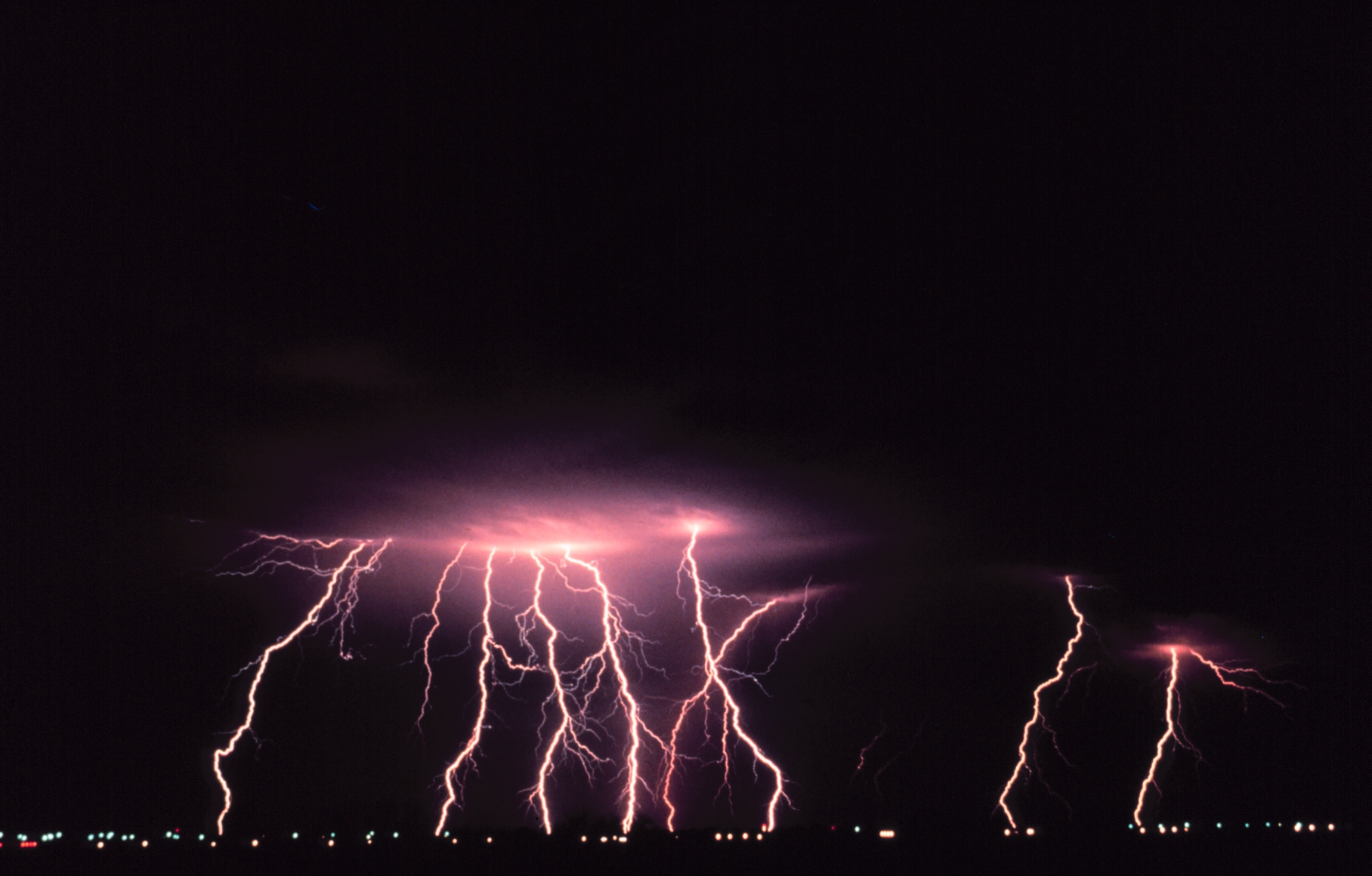

The photograph above is deliberately identified as ordinary lightning. Confusing an atmospheric context photo with evidence for the more unusual event would repeat exactly the mistake this investigation is designed to avoid.
What people mean by “ball lightning”
The term usually refers to a transient, roughly spherical luminous object reported during or near electrical storms. Eyewitness accounts sometimes describe slow drifting, a glow persisting for seconds, fading or vanishing abruptly, and, more rarely, an apparent explosive ending. Reported colors, sizes, locations and behaviours vary enormously.
The descriptions form a research problem, not a validated catalogue of one uniform species of object. Some accounts may involve poorly recognized ordinary lights, electrical discharges, burning fragments or perceptual effects. Others may document rarer atmospheric electrical processes. The 2021 historical review in History of Geo- and Space Sciences discusses how observations by scientists and trained witnesses accumulated, along with their limits.
The distinction matters: an actual luminous event, its video representation, a witness’s inferred distance and a proposed source of energy are four different claims. They require different kinds of evidence. A dramatic narrative that collapses them into one conclusion is scientifically weaker than the observation it started with.
The lucky 2012 observation in Qinghai
On July 23, 2012, at about 21:55 local time, a group from Northwest Normal University in China was observing normal cloud-to-ground lightning on the Qinghai Plateau. They were not specifically searching for a floating sphere. Two slitless spectrographs, including a high-speed camera and a conventional video camera, were already in use when a lightning strike was followed by a short-lived luminous object.
Jianyong Cen, Ping Yuan and Simin Xue reported the event in Physical Review Letters in January 2014. Their instruments observed from approximately 900 metres away. The conventional video recorded a luminous duration of 1.64 seconds; the high-speed camera captured only the later portion because of its recording window.
The object appeared near the lower end of the lightning channel, changed color from white toward reddish, and moved horizontally in the scene. The authors could analyse changing intensity and apparent size frame by frame. The observation is important because synchronized imaging and spectral measurements place stronger constraints on an event than a single recollection or an unlabeled photograph.
But even a well-recorded event has limits. The bright region was estimated to be several metres across in the recording, while the American Physical Society’s accompanying science analysis cautioned that the actual object was substantially smaller than the glowing appearance suggested. Distance, optics and scattering matter. The researchers did not recover a physical specimen or determine an exact composition from a laboratory sample.
A spectrum is a fingerprint—but not a full explanation
A spectrograph separates light into wavelengths. Certain emitting atoms can produce identifiable line patterns. The Qinghai measurements contained emissions consistent with silicon, iron and calcium, all associated with soil, as well as features associated with the atmospheric environment. This was unlike assuming every glowing blob has no measurable physical attributes.
The finding supports the possibility that a cloud-to-ground strike disturbed and heated soil material that then participated in a short-lived luminous process. It is evidence consistent with a soil-related origin for that event. It is not proof that every historical report of ball lightning is caused by the same mechanism, or that researchers reconstructed the complete energy budget and life cycle of the light.
APS noted that the instrument range did not permit every expected element to be detected; the absence of an aluminum line, for example, was not evidence that no aluminum existed. The proper interpretation is bounded by what wavelengths the detector could measure and by the difference between observed emission lines and an independent chemical assay of a sample.
The original 2014 journal article is the primary source; the APS analysis gives a readable account of why this record was a breakthrough without calling the phenomenon solved.
Could lightning make a glowing cloud from soil?
One prominent proposal predates the Qinghai observation. In a 2000 paper in Nature, John Abrahamson and James Dinniss explored a mechanism in which a normal lightning strike alters silicate soil, ejecting small energetic particles and networks into the air. As the particles slowly oxidize, chemical energy can be released as heat and light.
The researchers described laboratory work using lightning-like discharges on soil, which produced nanoparticle aggregates with properties relevant to their model. That is a plausible route for some luminous events, and the later finding of soil-element emission lines provides a valuable connection between model prediction and an actual field recording.
There is an important remaining gap. A laboratory discharge that creates glowing or reactive material does not prove that the full natural ball-lightning phenomenon has been recreated under the same conditions, nor that other reported forms or durations follow the same chemistry. Competing electromagnetic and plasma models have been investigated. The criteria for a successful explanation should include predicted spectra, lifetimes, motion and energy requirements—and independent replication, not resemblance alone.
The 2023 Montana video: promising evidence or ordinary sparks?
The second case is useful precisely because the investigators refused to make a dramatic verdict. A security camera outside a residence near Bozeman, Montana, recorded unusual glowing objects during a thunderstorm in August 2023. Researchers Karl Stephan, Ronald Sonnenfeld and Janet Bertoloni analysed the clip in a paper published June 23, 2025 in the Quarterly Journal of the Royal Meteorological Society.
The objects came within roughly 10 metres of the camera, enabling more detailed geometric reconstruction than is typical for distant sky videos. The authors used landscape measurements, a model of camera optics, window reflections, timing and weather information to estimate position, brightness and movement. They also considered a nearby electrical distribution line.
At first glance, the camera suggested larger glowing spheres. However, the researchers reproduced an optical effect called blooming using a similar camera and bright test source. They found that the visible enlarged discs were artifacts of sensor saturation; much smaller ghost reflections helped estimate true object sizes at around 14–17 millimetres. This is a powerful reminder that a bright circle on a sensor does not directly measure a glowing object’s diameter.
The utility reported a power interruption during the same event. Burning material or sparks ejected by a power-line arc remained a plausible conventional alternative. The researchers did not prove that this mechanism had occurred, but they explicitly declined to label the video unambiguous ball lightning. Their careful uncertainty is a methodological strength, not a retreat from the subject.
How cameras create convincing false sizes
Digital sensors saturate when incoming light overwhelms their capacity to represent brightness. A small source can appear as a much larger, smooth, bright disc. Internal reflections between optical surfaces may produce faint duplicate or offset objects, sometimes called ghost images. Camera movement, automatic exposure and compression can further change apparent shape and colour.
In the Montana study, the experiment with a comparable camera reproduced enlarged bright discs and offset ghost images. That supported the optical explanation for the appearance of the objects, even though it did not settle exactly what was emitting light. A proper image analysis separates these questions:
- What was physically there? A light source or sources, which may be small
- What did the camera render? Saturated discs and artifacts shaped by its optics and settings
- What made the light? A possible electrical arc, burning fragment or more unusual process
- What would distinguish them? Independent angle, closer calibrated footage, physical traces and consistent timing with electrical equipment
This is also why DEVIL13’s Night-Sky Evidence Kit advises preserving the original media and camera details. A spectacular crop from a repost loses crucial information about scale and provenance.
The two cases are not contradictory
QINGHAI / JULY 2012
Strong spectral observation
A natural lightning event followed by a 1.64-second luminous phenomenon; spectrographs detected lines consistent with soil elements. Supports a class of natural processes, but not a universal solved theory.
BOZEMAN / AUGUST 2023
Detailed but ambiguous video
Nearby glowing objects, a reconstructed camera perspective and a correlated electrical event; sensor blooming and possible power-line sparks prevent confident identification as ball lightning.
The first offers strong physical measurements of an event interpreted as ball lightning. The second shows how to keep an intriguing candidate honest when ordinary mechanisms remain viable. Scientific confidence can differ by event without requiring that every witness was mistaken or every glow has the same cause.
What still needs to be explained
- Varied lifetimes and forms. Does one physical mechanism account for seconds-long spheres, faster flashes and reports from different environments?
- Energy source. For each verified event, how much energy was radiated and what processes could sustain the light?
- Provenance and calibration. Can synchronized sensors establish position, spectrum, physical size and motion without relying on appearance alone?
- Competing observations. Can researchers distinguish true atmospheric luminous structures from power-line fragments, reflections and other familiar sources?
- Replication. Can a mechanism predict features that are observed repeatedly, outside a controlled laboratory, under natural storm conditions?
Proposals that ignore the strongest counterexamples or rely solely on anecdotal accounts cannot answer these questions. Equally, the fact that not every sighting is identified does not prove an exotic source. The unresolved portion should be stated with the smallest possible claim.
DEVIL13 evidence assessment
Documented observations
Cen, Yuan and Xue published an instrumented 2012 thunderstorm observation in 2014: a luminous event following cloud-to-ground lightning, recorded with two spectrographs, lasting 1.64 seconds, with emission lines consistent with several soil-derived elements. Stephan and colleagues analysed a 2023 security-camera video in a 2025 paper, including calibrated geometric and camera-optical tests. Both are published scientific research records rather than third-hand viral reports.
Supported interpretations
The 2012 evidence is consistent with a natural electrical process involving soil material; it supports parts of soil-vaporization/nanoparticle proposals without uniquely proving them. The 2025 camera data support saturation, blooming and ghost reflections as explanations for the unusually large appearance of much smaller glowing objects.
What remains unresolved
No single accepted physical model has been demonstrated to account for the full variety of historical ball-lightning descriptions. The 2023 Montana video may depict a ball-lightning-like process, but a power-line arc and burning fragments remain a credible alternative. Neither paper establishes an extraterrestrial object or a new physical law.
What could change the assessment
Independently calibrated synchronized footage and spectra; reproducible field predictions for emission chemistry and lifetime; verified source and energy information; and ordinary-source exclusion including local power infrastructure would sharpen individual conclusions. A popular video without preserved original files or a claimed “orb” shape alone would not.
Finding: Ball-lightning-like events have credible instrumented documentation, but the complete physical explanation is still under investigation. The most valuable advance is not a confident label—it is the ability to discriminate among explanations from measurements.
Safety and source desk
Thunderstorms are life-threatening. The U.S. National Weather Service advises going into a substantial building or enclosed metal-topped vehicle when thunder is heard and remaining sheltered for at least 30 minutes after the last thunder. Never approach electrical lines or attempt to reproduce a lightning discharge to investigate a suspected luminous object.
- Cen, Yuan and Xue, Physical Review Letters 112, 035001 (2014) — original 2012 Qinghai optical and spectral study.
- American Physical Society, “First Spectrum of Ball Lightning” (2014) — explanation of soil emission lines and the distinction between luminous appearance and physical size.
- Abrahamson and Dinniss, Nature 403, 519–521 (2000) — hypothesis involving oxidizing soil-derived nanoparticles; not a final confirmed mechanism.
- Stephan, Sonnenfeld and Bertoloni, Quarterly Journal of the Royal Meteorological Society (2025) — Montana video, camera blooming controls and viable power-line-arc alternative.
- Keul, History of Geo- and Space Sciences 12, 43–65 (2021) — historical observations by scientists and trained professionals.
- C. Clark / NOAA National Severe Storms Laboratory, conventional thunderstorm photograph, March 1978 — public-domain contextual illustration, explicitly not ball lightning.
- National Weather Service, Lightning Safety Tips — safe observation rules.
DEVIL13 editorial synthesis prepared November 25, 2026. This article does not claim that DEVIL13 performed spectroscopy, reviewed unpublished camera files, recreated ball lightning, or inspected any of the original objects. It distinguishes the primary researchers’ measurements from their interpretations and from unresolved alternatives. Figures and videos from copyrighted scientific studies are linked to their publishers rather than republished. The illustrative NOAA photograph documents ordinary lightning only.
For the measurement terms, consult the glossary on emission spectra, sensor blooming and optical ghost images. Continue through The Phenomena Files, compare the Hessdalen investigation, and try the 13-check night-sky observation guide.