DEVIL13 / The Forbidden Library / Alchemy, Symbols & History / Research synthesis / November 15, 2026
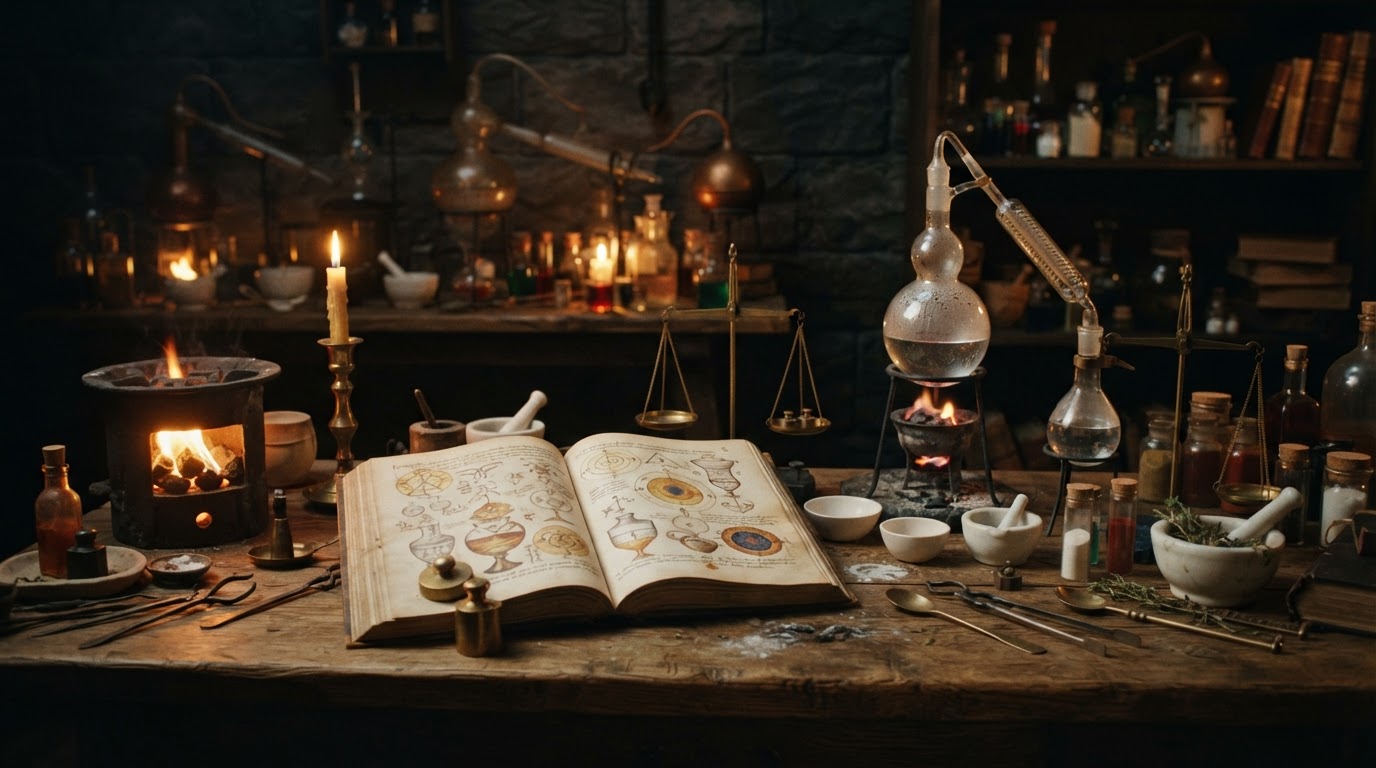
Editorial artwork is an original AI-generated conceptual illustration, not a photo of an authenticated historical alchemical laboratory.
Alchemy was not simply a failed attempt to make gold. It was also a laboratory craft, a theory of matter, a system of visual symbolism, an intellectual tradition and, for some practitioners, a path toward spiritual understanding. Its history stretches across cultures and centuries. Describing it only as ‘magic chemistry’ makes the real manuscripts and experiments harder to understand.
The Getty Research Institute’s alchemy collections and the Science History Institute preserve books, images and artifacts documenting these overlapping meanings. They show how historical alchemists brought together reading, practical know-how, religious ideas and theories about how materials change.
The popular myth: a laboratory devoted only to gold
In the most familiar version of the story, an alchemist spends a lifetime seeking the philosophers’ stone, a mysterious material capable of transforming base metals into gold and perhaps prolonging life. This pursuit was real as an aspiration in some traditions, but it was not the whole activity.
Early modern practitioners also studied minerals, alloys, metal extraction, glass, pigments, medicines, distillation and other material processes. The Science History Institute’s Fire and Gold exhibition documents the interplay of workshops, manuscripts, metallurgical experiments and coded language. These processes took place in a world whose categories were not the same as modern chemistry.
A furnace, a vessel and a book might stand next to a religious image because the practitioner did not necessarily separate practical technique, natural philosophy and spiritual explanation the way a present-day textbook would.
The symbolism was not merely decoration
Alchemical manuscripts contain birds, kings and queens, strange marriages, colors, planetary symbols, fire, vessels and many other images. A modern reader may be tempted to treat every image as a single universal secret code. The historical record is more complicated.
The Getty’s digitized Art of Alchemy exhibition includes a 1606 book of alchemical formulas with illustrated allegories, seventeenth-century engravings and images of equipment. Some pictures communicate an operation, some encode a practitioner’s theory, and some use moral, theological or cosmological imagery. The intended meaning depends on the specific book, its author, its date and its readers.
A symbol can therefore be historically meaningful without being a supernatural instruction. It can represent a method, make an analogy, conceal knowledge, attract patrons or express a worldview. Identifying which role it played requires manuscript study, not just intuitive pattern matching.
A tradition that moved across languages and regions
The Metropolitan Museum of Art’s account describes a network of Greco-Egyptian texts, artisanal traditions and materials that reached medieval and early modern Europe through the Islamic world. The historical development was not a solitary European invention. Translation, migration and the exchange of techniques shaped the texts and workshops that later Europeans encountered.
The Cambridge History of Science chapter on medieval alchemy emphasizes its relationship with chemical and mineral technology and describes how Latin authors engaged with Arabic learning. This wider context helps explain why the same practice can look different in different centuries.
Because alchemy was often linked to religious and philosophical interpretation, attempts to divide the entire tradition neatly into ‘science’ and ‘magic’ can impose categories its practitioners did not use in the same way.
Alchemy in a laboratory: techniques, failures and results
Alchemy helped establish and circulate habits of laboratory work that influenced the later development of chemistry. That does not mean every alchemical doctrine was scientifically correct. It means some practitioners developed effective procedures while pursuing explanations and objectives that modern chemistry does not accept.
Princeton University’s digital exhibition Experimenting with the Past documents how researchers reconstruct historical chemical processes using old recipes. It also describes seventeenth-century practitioners such as George Starkey and Isaac Newton working with antimony and other substances. These reconstructions are especially instructive: historians must interpret the original recipe, clarify historical material names and distinguish a successful reconstruction from proof of the original author’s theory.
A historically effective process—such as isolating a metal or producing a pigment—does not validate all the cosmological claims surrounding it. Likewise, an incorrect theory can coexist with careful observation and craft knowledge.
Isaac Newton and the danger of tidy history
Newton is often introduced only through physics and mathematics. Yet surviving manuscripts show he studied and copied alchemical material. Princeton’s exhibition includes Newton’s notes on George Ripley and other texts. The point is not that Newton secretly proved mystical transmutation. It is that famous thinkers worked within intellectual worlds more complicated than our modern disciplinary categories suggest.
Reading an old scientific mind through a contemporary division between ‘rational genius’ and ‘occult fool’ prevents us from understanding the development of ideas. Historical context does not make a false claim true; it makes the people who investigated it intelligible.
Three separate questions about alchemy
- What did practitioners do? Seek surviving recipes, instruments, manuscripts, laboratory remains and modern historical reconstructions.
- What did practitioners believe? Examine philosophical and religious writings, symbols, dedications and debates within particular traditions.
- Did a claim work? Define the precise claim and test it with appropriate physical, chemical or historical evidence. A successful pigment recipe does not prove the philosophers’ stone exists.
Why one mysterious image is rarely enough
The same emblem may appear in several manuscripts with altered context. A lion, a sun or a pair of figures could be an alchemical illustration, a conventional artistic motif or an author’s personal metaphor. Without date, provenance and accompanying text, asserting a precise ‘hidden meaning’ is often little more than a guess.
That is not a reason to dismiss symbolism. It is a reason to take it seriously enough to examine the actual documents. The Getty Research Institute has assembled manuscripts specifically so researchers can compare how alchemical imagery changed from the early modern period onward.
What can we responsibly conclude?
Documented: Historical alchemists pursued both material transformations and wider philosophical or spiritual ambitions. Surviving manuscripts show experimental apparatus, technical recipes, symbolic illustration and a long, culturally interconnected history.
Interpreted: The precise role of many symbols, coded passages and individual laboratory processes. Scholars compare texts, art, material evidence and reconstructions to weigh possible meanings.
Not established: That the traditional philosophers’ stone existed as described, that base metals could be converted to gold through ordinary historical chemical recipes, or that all alchemical traditions taught one secret unified doctrine.
A place for alchemy in The Forbidden Library
DEVIL13 will treat alchemy as a meeting point between human imagination and work with the physical world. We can appreciate the art without pretending every allegory is a scientific finding; we can study techniques without rewriting history to make every experiment a precursor of modern chemistry.
The most interesting question may be this: when humans imagine that matter can be transformed, how much do they change the material world—and how much do they change themselves? The question is philosophical, not an assertion that the processes of nature obey belief.
Sources and collections
- Getty Research Institute — Alchemy Special Collections, archival collection and historical framing.
- Getty Research Institute — The Art of Alchemy, digitized books, emblems and apparatus.
- Science History Institute — Fire and Gold: The Art of Alchemy (1450–1850), museum exhibition.
- Science History Institute — Alchemists & Early Scientists, linked research resources.
- Princeton University Libraries — Experimenting with the Past, experimental reconstructions and historic texts.
- The Metropolitan Museum of Art — Alchemy, Science, and Innovations in the Decorative Arts, early modern craft history.
- William R. Newman, Medieval Alchemy (2013), The Cambridge History of Science.
Method note: Original editorial synthesis of research collections and published scholarship. DEVIL13 has not conducted chemical experiments or inspected original manuscripts in person. Last reviewed November 15, 2026. Research method · Return to the Library.