DEVIL13 / The Thirteenth Mind / Perception & Meaning / Research synthesis / November 15, 2026
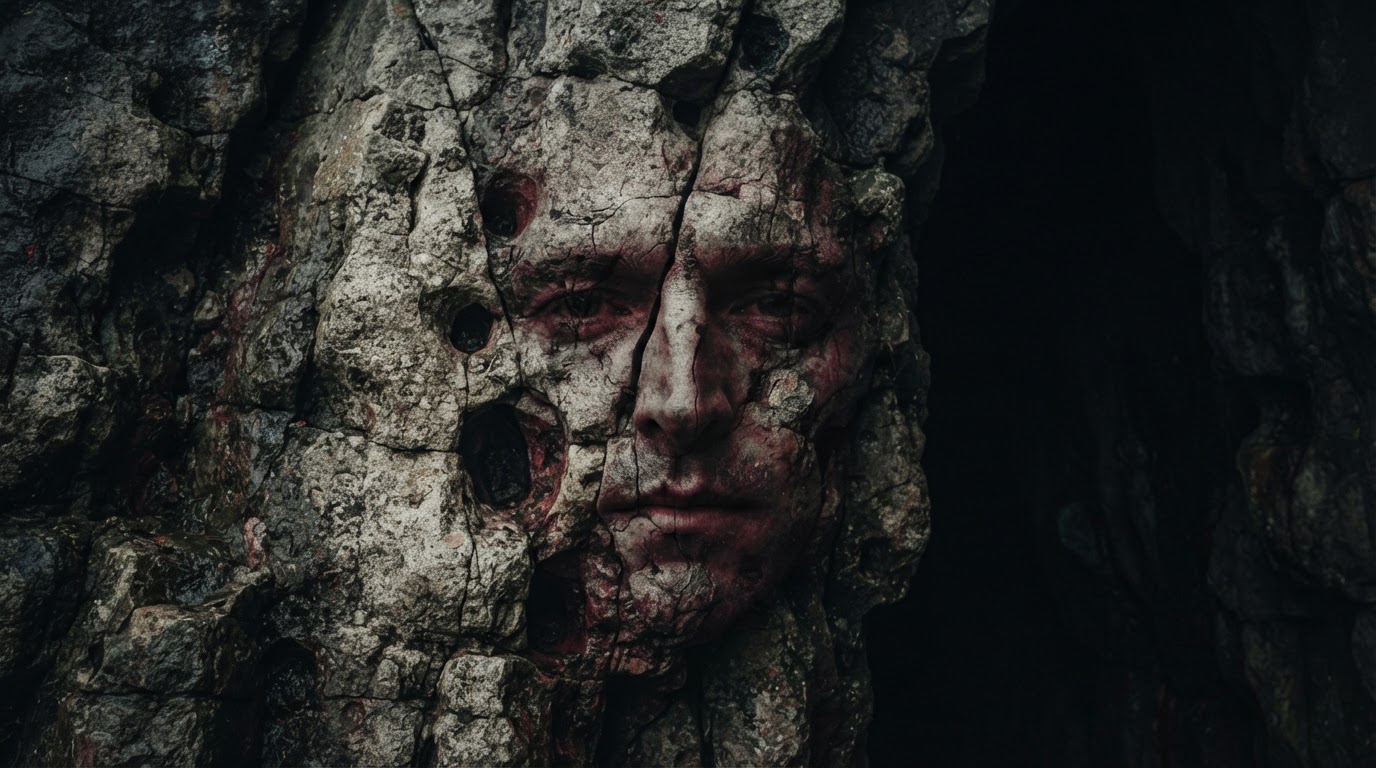
Editorial artwork: an original AI-generated illustration of pareidolia, not a photograph of Mars or a study stimulus.
Have you ever seen a face in a cloud, a wall socket or the grain of old wood? It can feel remarkably real even when you know the object has no face. Psychologists call this tendency pareidolia: perceiving familiar patterns in ambiguous or unrelated sensory input. Face pareidolia is a particularly well-studied example.
That does not mean the eyes are lying or that the observer is irrational. It means perception is an active interpretation of incoming information, shaped by the visual system’s sensitivity to features that resemble faces. The phenomenon offers one of the clearest ways to study how a plausible impression differs from an established explanation.
The most famous case: the ‘Face on Mars’
In 1976, NASA’s Viking 1 orbiter photographed a landform in the Cydonia region of Mars while searching for potential landing sites. Under that illumination, shadows across the roughly 1.5-kilometer-wide formation created the appearance of eyes, a nose and a mouth. The image became a magnet for claims about an extraterrestrial monument.
NASA’s original image description notes several important details. The spacecraft observed the formation from a substantial distance. Shadows created apparent facial features, and transmission errors contributed to the speckled image—including parts of what some viewers treated as facial details. The observed object was real; the inference that it was an artificial face was not established.
A later Mars Global Surveyor observation from April 8, 2001 recorded the same formation with much finer spatial detail and different viewing conditions. The mountain-like landform no longer presented the same compelling face. The additional evidence made a natural geological interpretation more persuasive. The first image was not a hoax; it was an incomplete view of a real surface feature.
This is the principle of a good test: if the idea is that a formation is a built monument, what would we expect to see when the lighting and resolution change? A hypothesis must survive the better observation, not just the striking first impression.
Why a socket can seem to look back at you
Face recognition matters in social life. A face can convey attention, expression and identity, so the visual system is sensitive to face-like arrangements. That processing need not wait for us to consciously decide ‘I am looking for a face.’
In a 2020 Nature Communications study, Susan Wardle and colleagues examined brain responses to ordinary objects that look like faces. Their experiments indicated rapid face-related processing in response to illusory facial configurations, followed by more differentiated responses. The findings are consistent with face pareidolia being rooted in visual-processing mechanisms rather than purely in a slow, deliberate storytelling process. Read the study.
Another 2020 paper, by Colin Palmer and Colin Clifford in Psychological Science, tested how looking at objects with face-like features could bias judgments of where actual human faces were looking. Their results suggest that at least some mechanisms used in social face perception are recruited by illusory faces in objects. Research abstract and citation.
These experiments do not show that people who see faces are gullible. They help explain why the appearance can be vivid and immediate even when the viewer knows the ‘face’ is an inanimate object.
An interesting 2025 finding: symmetry matters
A 2025 study in Cognition investigated pattern recognition using synthetic noise images with differing visual properties. The researchers found that patterns resembling the statistical structure of natural scenes prompted more reports of animate forms, and that vertical symmetry was associated with a larger share of perceived animate figures. Faces were prominent among the reported forms, but not the only ones. The published abstract explains how the researchers varied image statistics and symmetry.
This offers a careful insight: some ambiguous patterns are more likely than others to invite a face interpretation. Seeing one is not random nonsense. It reflects how our visual system responds to available cues.
Does explaining pareidolia explain everything unusual we perceive?
No. An explanation of one class of perceptual illusions should not be stretched into an automatic dismissal of every unusual observation, dream, religious experience or personal testimony. Different claims require different tests. In the same way, the fact that perception can mislead does not mean that every meaningful-looking pattern is an illusion.
For example, an archaeological object can indeed carry a deliberate face motif. The way to distinguish it from accidental marks is to investigate material context, possible manufacture, provenance, comparisons and independent observations. A striking resemblance is a starting clue, not the final argument.
An evidence checklist for mysterious images
- Original file: Is there an unedited, properly sourced image rather than a recropped social-media copy?
- Multiple views: How does the shape appear from another angle, distance, time or lighting condition?
- Resolution: Could compression, sharpening, noise or missing data generate apparent details?
- Context: What is the material or landscape, and what natural or manufactured processes are plausible?
- Independent assessment: Can informed observers see the alleged structure without being told what to expect?
- Predictions: If the shape were deliberately made, what measurable evidence should be present beyond resemblance?
The checklist does not force a predetermined answer. It raises the standard of what counts as support. The Face on Mars became less mysterious because additional observations tested the implied construction claim.
What is documented, inferred and unproven?
Documented: People reliably perceive face-like patterns in some everyday objects, and scientific studies can measure aspects of the effect. The Cydonia landform was imaged by multiple NASA spacecraft under different conditions.
Interpreted: Visual-system processing, expectations, experience and image statistics can help explain which ambiguous patterns people interpret as faces and how vividly.
Not established by resemblance alone: That a rock, cloud, stain or distant landform is an artifact designed to depict a face—or that a coincidental resemblance has a supernatural message.
The lesson for The Thirteenth Mind
Perception is not the same as deception. Most of the time, rapid pattern recognition is helpful. Sometimes a feature that is useful for social life also produces compelling impressions of something that is not really there. The point is to treat the impression respectfully and investigate its cause.
The next time a shape seems to look back at you, try asking two questions: What did I directly see? And what story did I add to what I saw? Those two questions are the entrance to Door 04: How Does Perception Shape Reality?.
Research sources
- NASA/JPL — Geologic ‘Face on Mars’ Formation, original Viking 1 context and imaging limitations.
- NASA/Mars Global Surveyor — Highest-Resolution View of ‘Face on Mars’, 2001 follow-up.
- Wardle et al. (2020), Rapid and dynamic processing of face pareidolia in the human brain, Nature Communications.
- Palmer & Clifford (2020), Face Pareidolia Recruits Mechanisms for Detecting Human Social Attention, Psychological Science.
- Peterson & Clifford (2025), Image primitives supporting perception of animate forms, Cognition.
- NASA (2022), Celebrating Halloween and Investigating Ghoulish Rocks From the Red Planet, geological explanations and pareidolia.
Editorial method: This article is a research-grounded synthesis, not a firsthand neuroscience experiment or direct analysis of Martian image data. Sources reviewed November 15, 2026. No conclusion about a particular person’s perceptions is implied. Read our research standards.