RESEARCH TOOLKIT / REAL DATA / FILE 024
Which sailing stone went farther?
Two stones, two ways to measure a journey. In about five minutes, you can check the same distances the Death Valley field team reported and see why a fair answer needs a time window.
Download the fillable worksheet (PDF, 2 pages) or work through the questions below. Open each answer after you have a number in mind.
Start with the measurements
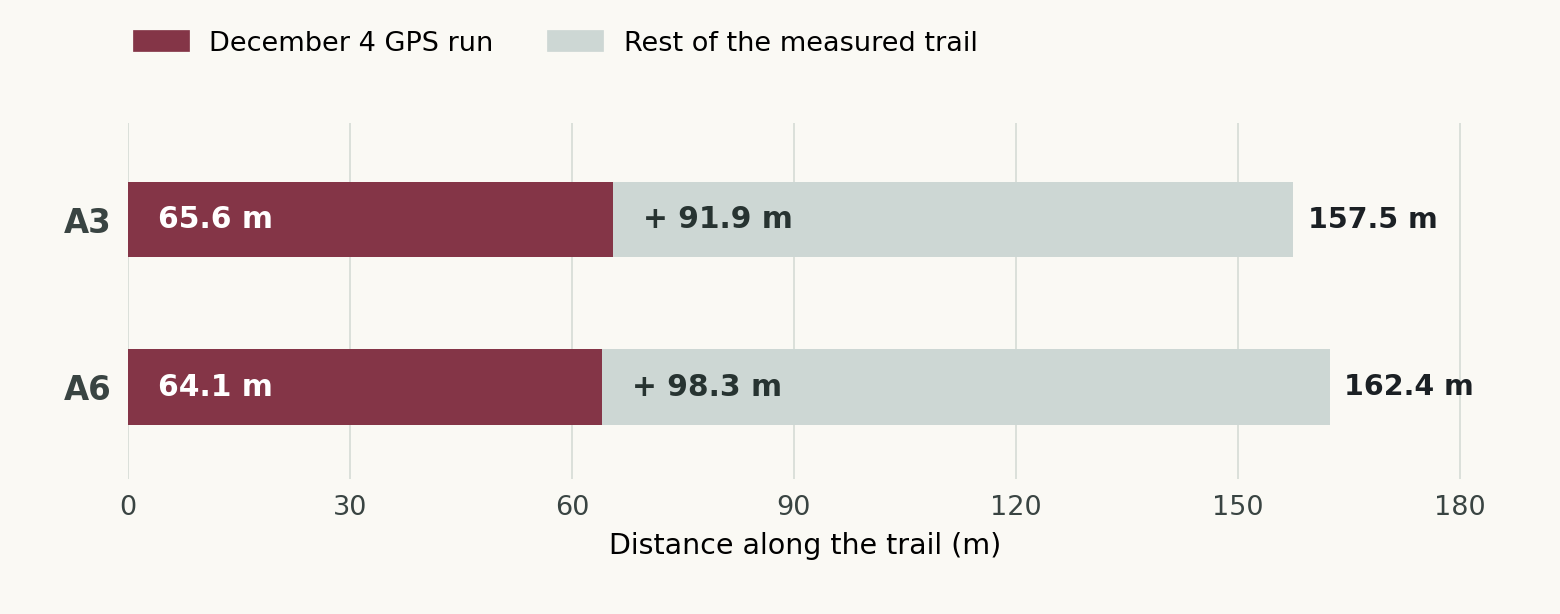
On December 4, 2013, two rocks fitted with GPS loggers travelled across Racetrack Playa. The first distance records a single sixteen-minute movement. The second gives the length of each complete trail after additional movement. Read across a row to compare the two periods for one rock.
| Stone | December 4 GPS run | Complete trail |
|---|---|---|
| A3 | 65.6 m | 157.5 m |
| A6 | 64.1 m | 162.4 m |
Before opening the answers, write down two names. Which rock went farther during those sixteen minutes? Which left the longer trail overall?
Check your reasoning
1. Which stone went farther during the GPS run?
A3, by 1.5 metres. Start with the two numbers in the GPS column. Subtract 64.1 from 65.6. Both values cover the same interval, so this comparison answers a question about that December morning.
2. Which stone had the longer complete trail?
A6, by 4.9 metres. Its complete trail measured 162.4 metres. A3’s measured 157.5 metres. The order reverses when you include the travel that happened after the recorded run.
3. How much of each trail lies outside that run?
A3 has 91.9 metres remaining. A6 has 98.3 metres remaining. For A3, subtract 65.6 from 157.5. For A6, subtract 64.1 from 162.4. The lighter part of each bar shows that difference.
4. Can you tell when the extra distance was covered?
The authors report that both rocks moved again after their logger batteries ran down. The remaining distance could be spread across one or more later movements. These four numbers do not give the dates, speeds or number of those movements. To recover timing, look for a working logger or a camera with a time stamp and a fixed reference point.
Try the same question on a different record
A hiker’s watch recorded eight kilometres before the battery stopped. A later survey put the whole route at eleven kilometres. You can work out how much of the route the watch missed. To estimate the hiker’s speed over those final kilometres, what other measurement would you ask for?
Check the hiking example
The watch missed three kilometres. To calculate average speed for that section, you also need the time taken to cover it. The hiker’s earlier pace can support an estimate, provided you state the assumption and allow for a change of terrain or a stop.
Read how ice moved the stones or choose another exercise from the Research Toolkit. The figures in the table come from the original field study.