DEVIL13 / The Forbidden Library / Symbols, Language & History / November 15, 2026
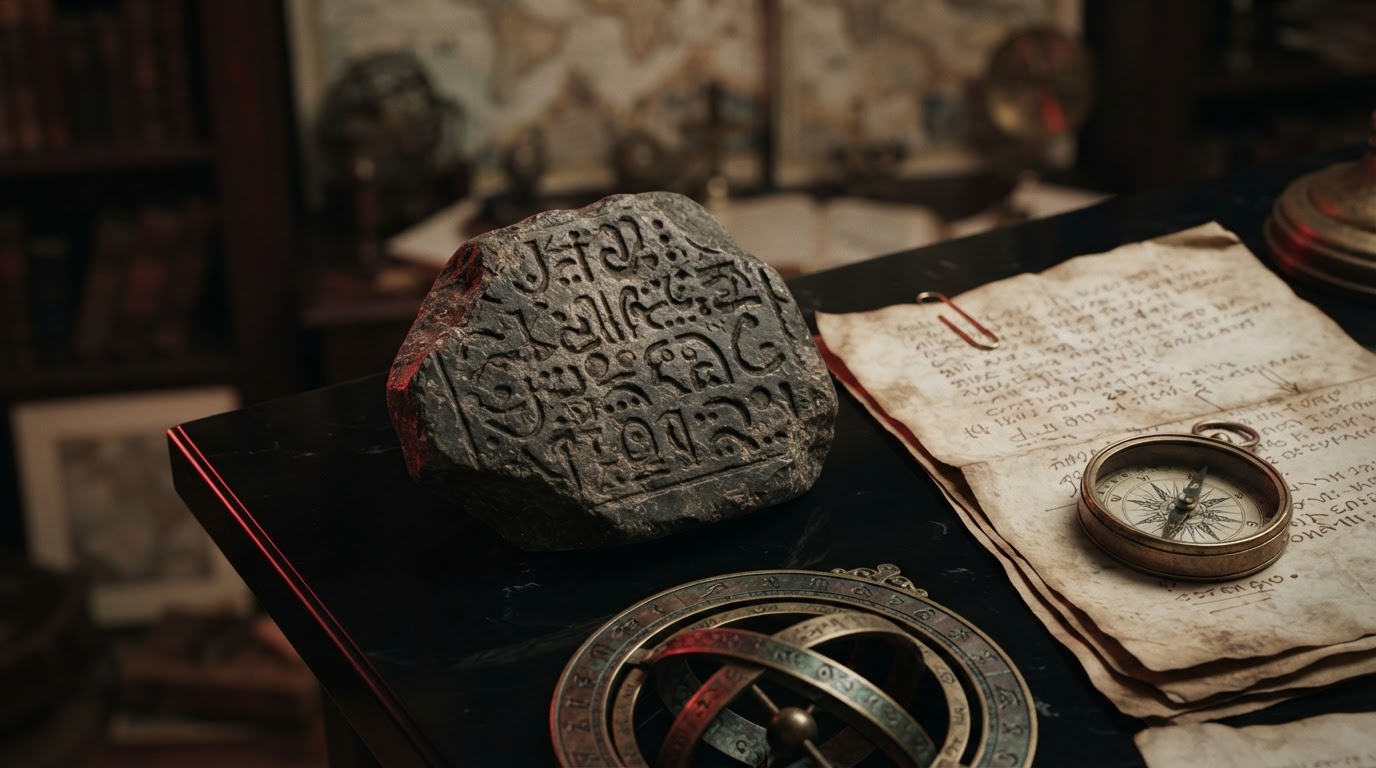
Original AI-generated conceptual artwork; not an image of the Rosetta Stone or an authentic historical inscription.
A symbol can carry truth. It cannot certify every claim someone makes about it. A flag can represent a community, a written word can communicate an idea, and a carved inscription can preserve a real event. But when someone says that an ancient emblem proves a supernatural power, a secret civilization or a universal code, the reasoning needs more than the emblem itself.
Symbols inhabit two worlds: the physical artifact we can inspect, and the interpretation that gives it meaning. Understanding the first does not automatically settle the second. The Rosetta Stone and early-modern alchemical manuscripts show why that difference matters.
How signs acquire meaning
The philosopher Charles Sanders Peirce developed a distinction among icons, indices and symbols. An icon works through resemblance: a portrait resembles a face. An index works through a factual connection: smoke may indicate combustion. A symbol often depends on an established convention: spoken and written words, flags and agreed signs carry meanings that communities learn.
These are analytical categories, not sealed boxes. A drawing may resemble an object and also have a culturally assigned meaning. The Stanford Encyclopedia of Philosophy’s Peirce’s Theory of Signs explains the distinction and its changing role in Peirce’s work.
A circle in one manuscript might be a mathematical diagram, in another a cosmological emblem, and in another simply a border. The shape alone cannot tell us which role it played. Material setting, accompanying text and historical context provide the evidence.
The Rosetta Stone: what a successful decipherment looks like
The Rosetta Stone was found in 1799 near Rashid, Egypt. The British Museum identifies it as a decree from 196 BCE written in Egyptian hieroglyphs, Demotic and ancient Greek. Comparison with the Greek text and the work of multiple scholars, notably Thomas Young and Jean-François Champollion, helped unlock the principles by which Egyptian hieroglyphs recorded language.
The breakthrough was not a modern observer assigning whatever spiritual interpretation a carved bird or reed suggested. It came from recognizing phonetic relationships, comparing names and testing the reading rules against additional inscriptions. A picture-like character can function as a written sign for sound, not only an abstract idea.
The British Museum’s exhibition on decipherment and its historical education guide describe the difficulty of moving beyond assumptions about mystical wisdom to coherent linguistic readings.
Importantly, a single parallel inscription was not the entire decipherment. It provided a powerful route to hypotheses that could be checked and refined. The method ultimately matters more than a dramatic first impression.
The alchemical symbol with many possible readings
Now imagine an early-modern alchemical book with a lion, two crowned figures, or a bird standing inside a vessel. You may be looking at an artistic allegory, a description of a laboratory process, a religious metaphor, or a combination. The same image might not mean the same thing to every author.
The Getty Research Institute’s Art of Alchemy project investigated the influence of alchemy on artistic practice and artisanal knowledge. Its digital exhibition provides manuscripts, apparatus and historical illustrations that let readers examine particular examples.
A historically documented symbol does establish that somebody used an image within a tradition. It does not establish that all the physical or supernatural claims associated with the tradition were correct. A practical pigment recipe may work even when the metaphysical explanation around it does not.
Why universal symbol dictionaries fail
Online lists sometimes attach a single fixed meaning to every triangle, serpent, eye, sun or number, across all places and centuries. That often erases cultural differences, merges unrelated traditions and attributes later interpretations to earlier people.
An apparent match is only a clue. To establish historical influence, researchers need dates, provenance, associated writing, comparable objects and some plausible route by which people or ideas traveled. Simple designs can also arise independently.
This does not make cultural symbolism meaningless. It means its claims deserve the same care as claims about events and physical objects. Knowing how a community interpreted an emblem can be a verifiable historical fact. Whether an emblem has a physical power is a different kind of proposition.
Five checks for an extraordinary interpretation
- Find the original: Is the object traceable to a museum, archive or documented excavation, or only to a cropped image?
- Date the evidence: Distinguish when an object was made, when its text was written and when its proposed meaning first appeared.
- Identify its users: Which person or community used the sign, and in what setting?
- Compare contemporary sources: Do writings or related artifacts support the proposed interpretation?
- Define a testable claim: If the symbol supposedly causes or reveals something in the physical world, what independent evidence would establish that?
What evidence supports
Documented: The Rosetta Stone bears parallel scripts and supported a historical decipherment. Early-modern alchemical books contain complex allegories with identifiable cultural and technical contexts.
Interpreted: The precise significance of an individual emblem may remain debated, especially when documents are incomplete.
Unproven: That every repeated shape is evidence of a worldwide secret teaching, or that drawing a sign proves the existence of supernatural powers.
Why the Forbidden Library studies symbols
A symbol can preserve an idea, express an aspiration or encode a language. It can be moving and historically revealing without being a shortcut to hidden physical laws. The deepest question is not simply what does this sign resemble? but who used it, why, and what could convince us that our interpretation is wrong?
Our Voynich Manuscript investigation examines an undeciphered contrast; our alchemy history shows how texts and laboratory techniques give visual imagery context. Door 06 provides a five-part interactive version of the inquiry.
Sources
- Stanford Encyclopedia of Philosophy — Peirce’s Theory of Signs.
- British Museum — Hieroglyphs: Unlocking Ancient Egypt.
- British Museum — Exhibition guide on decipherment.
- Getty Research Institute — Art of Alchemy project.
- Getty Research Institute — The Art of Alchemy collection.
Original DEVIL13 synthesis of museum and scholarly sources; not firsthand archaeological fieldwork or manuscript inspection. Reviewed November 15, 2026. See Our Method.