FILE 014 / THE FORBIDDEN LIBRARY
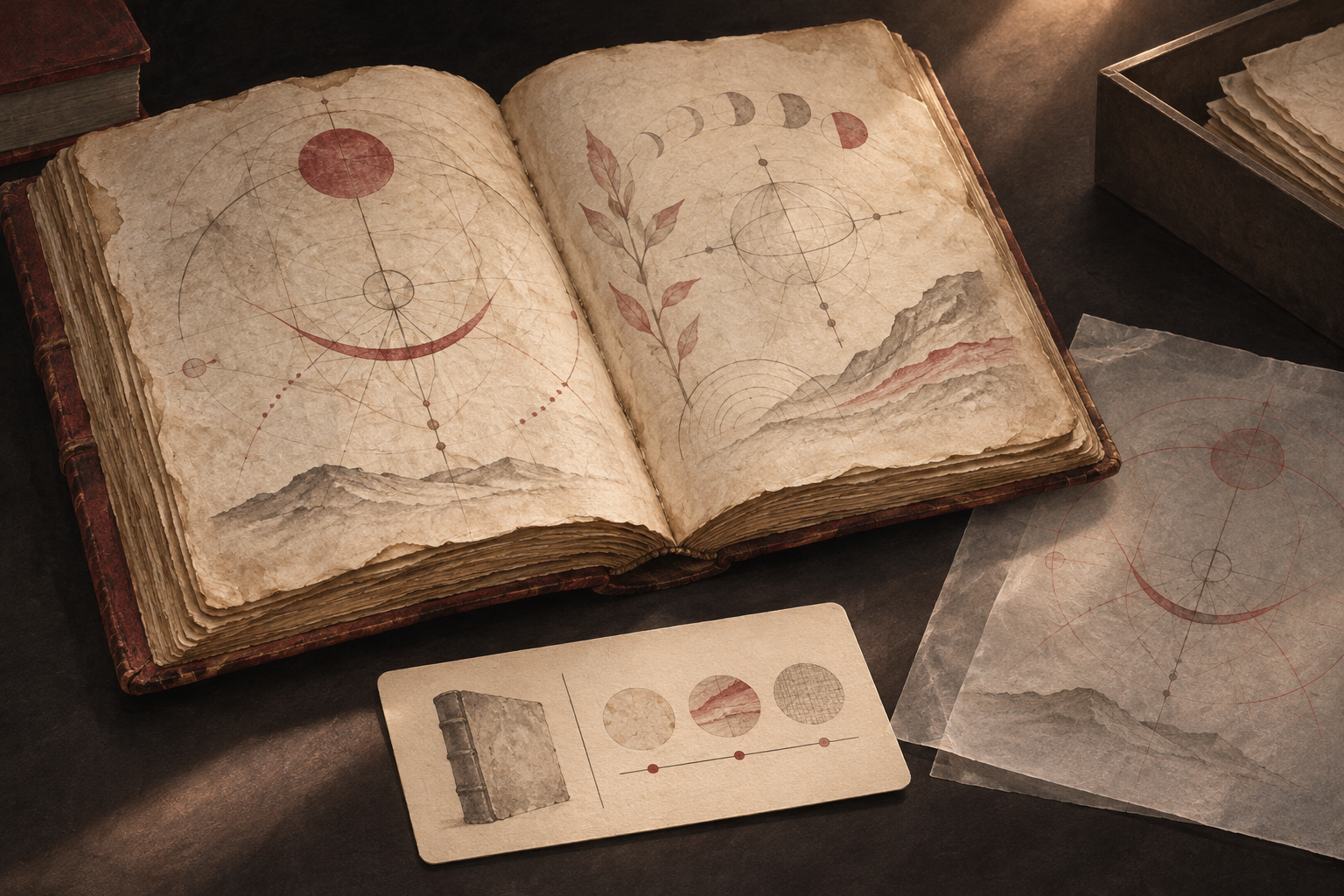
Featured artwork: an original AI-generated conceptual illustration, not a reproduction of a historical manuscript.
A grimoire may promise secret knowledge, invoke an ancient king and carry centuries of wear. Each detail invites a different question. Who made this particular book? How did its text reach the page? What can its survival actually tell us?
Reading it historically begins with those questions. A surviving manuscript is evidence of a text being written down. Annotations and ownership records may add evidence of how people read, collected or used it. Its promises need their own evidence. Keeping those layers separate makes the book more interesting: a document with a history that can be investigated.
Follow the trail: identify the object · check the author · test a date · compare editions · make a reading record
Start with the object in front of you
Find the holding institution, shelfmark and full catalogue record before interpreting a cropped image. A shelfmark identifies the item within a collection; a familiar title can belong to many different copies. Record the language, material, extent and stated dating, preserving qualifiers such as “circa,” “probably” or “late eighteenth century.”
Then separate four dates: the time in which the text claims to originate; the production of the surviving copy; the publication of an edition or translation; and the creation of the digital image. The date a file was uploaded may differ from the date it was digitised. Neither dates the physical object. A manuscript date does not automatically settle the first. Treat an undated gap as an open question, rather than filling it with the most exciting possibility.
A famous name is an attribution to examine
Queen’s University Belfast describes the Clavicula Salomonis, or Key of Solomon, as pseudepigraphical: attributed to Solomon although the tradition is thought to have originated around the fourteenth or fifteenth century. Its discussion also distinguishes that tradition from the particular German manuscript in its collection. The library’s account of MS 27/10/20 keeps those levels visible.
Pseudepigraphy makes authorship a research question. Write “attributed to Solomon” when that is what the evidence supports. Do not convert the name in a title into a verified signature, or assume every later copy is identical. Equally, a disputed attribution does not make the physical manuscript worthless: it can still show how authority was presented and transmitted.
A real date test: Wellcome MS.2000
Open Wellcome’s record for Clavis Inferni. The catalogue describes a Latin manuscript on vellum, with eleven leaves and coloured and gold drawings. It records an unusual Roman-numeral date, tentatively interpreted as 1717, while judging the handwriting to be late eighteenth century. The catalogue’s main date is also late eighteenth century.
- What the item says: it carries a date whose reading is uncertain.
- What the catalogue concludes: the script appears to belong to the late eighteenth century.
- What remains unresolved here: why the date and handwriting differ, and the exact year of production.
This is a catalogue-based comparison, not a fresh examination of the handwriting. The discrepancy is a reason to investigate; it does not by itself establish deliberate forgery. Keep the inscribed claim, institutional assessment and your own inference in separate sentences. That discipline prevents a tentative date from becoming a confident origin story.
Follow the text through copies and editions
A translation brings another layer of decisions. Wellcome’s digitised Key of Solomon is an English edition published in London by George Redway in 1889, with S. L. MacGregor Mathers identified as translator and editor. That is the edition you are reading, even when its title points towards much older manuscripts.
Before quoting a passage, inspect the title page, introduction and notes. Which manuscripts does the editor identify? Are variants recorded? Are additions, omissions or uncertain readings explained? Compare the same passage in another witness when possible. A modern edition can be useful while also being a historical object with its own editorial choices.
A transcription is another representation. Folger’s Early Modern Manuscripts Online distinguishes diplomatic, semi-diplomatic and regularized versions: they preserve or expand abbreviations and modernize spelling to different degrees. Check the project’s conventions before treating searchable text as a complete substitute for the page. Return to the image for a consequential word, supplied letter or ambiguous mark.
Read the book’s material history
The physical record can change the interpretation. Folger’s account of its manuscript grimoire V.b.26 describes marginal additions by successive readers and distinctive blue page numbers. The library bought an incomplete manuscript in 1958 and acquired its missing final pages in 2007. Those page numbers, together with other evidence, helped identify the separated section.
That example shows why provenance—the recorded history of ownership and custody—and physical arrangement matter. A missing leaf can interrupt a sequence. A later annotation may belong to a different reader. When you cannot inspect a feature yourself, attribute the observation to the catalogue or curator. A scan can support close reading without answering every question about binding, ink or construction.
Recover the setting, then limit the conclusion
Avoid making every surviving book fit one modern category. The Newberry’s Book of magical charms, Case MS 5017, is catalogued as an occult commonplace book mainly compiled by Robert Ashley. Its description places charms, ritual material and medical recipes in one section, with prayers and other material beginning from the opposite end. Its online transcription is identified as volunteer work.
Start by asking what this particular compiler gathered, how the sections relate and whose handwriting or annotation is being discussed. Do not project the contents onto an entire society. A copied remedy establishes that somebody recorded a remedy. To argue that it was performed, look for further evidence of use. To argue that it produced an effect, you need evidence capable of testing that outcome and alternative explanations.
Those are different research tasks. Historical documents can illuminate belief, aspiration, reading and practice without proving a supernatural mechanism. They can also leave important questions unsettled. You do not have to settle those questions before studying the document carefully.
Make a five-part reading record
- Identity: institution, shelfmark, full title, stable catalogue link and date checked.
- Layers: claimed author or origin; date of this copy; edition, translator or transcription used.
- Observation: the exact page or folio, what it contains, and whether you inspected the image or relied on a description.
- Interpretation: the narrow claim supported, with its uncertainty and plausible alternatives.
- Next evidence: another witness, a fuller provenance record, a specialist reading or an independent record of use.
Download the free Historical Source Record (fillable PDF, one page) to keep a retraceable account as you read. Use that record with the Evidence Engine. If the claim changes from “this text was copied” to “this ritual worked,” begin a new evidence assessment. Return to the Forbidden Library’s Source Desk to follow another source, or compare the distinction between objects, symbols and later stories in our investigation of alchemy.
Sources and research note
Checked November 18, 2026. This guide uses the institutions’ own catalogue records and collection explanations. Dates and physical descriptions above are attributed assessments, not results of independent manuscript examination. The reading workflow and limits on inference are DEVIL13’s synthesis.
- Queen’s University Belfast: Clavicula Salomonis, MS 27/10/20 — attribution and the distinction between a text tradition and a surviving copy.
- Wellcome Collection: Clavis Inferni, MS.2000 — material, language and competing date indications.
- Wellcome Collection: Mathers’s Key of Solomon, 1889 — edition and publication details.
- Folger: EMMO transcription approach — the differences between transcription formats.
- Folger: Lost and Found: A Manuscript Grimoire — reader additions and the identification of separated leaves.
- Newberry: Book of magical charms, Case MS 5017 — compilation, physical sections and transcription status.